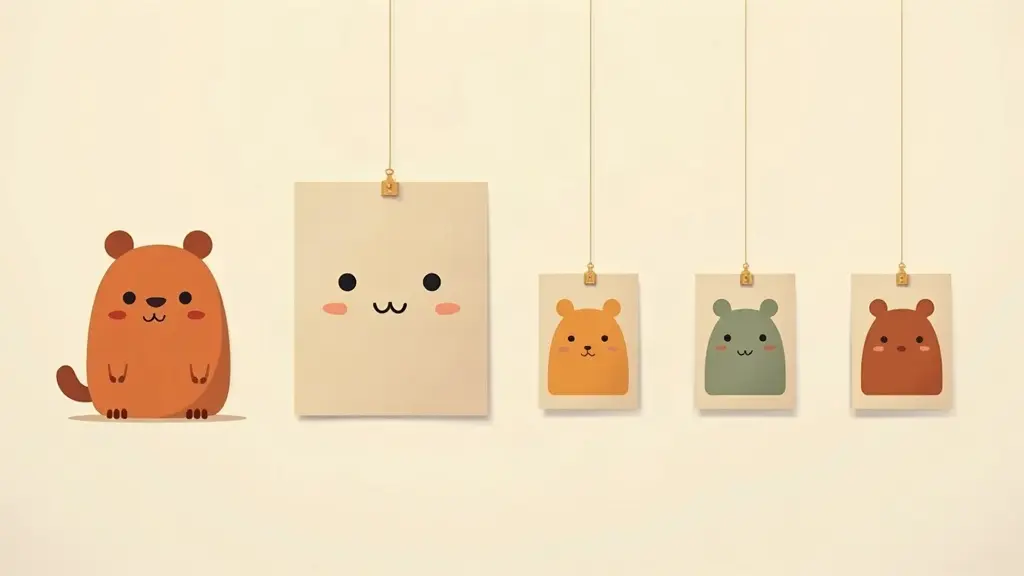
- Creating a single illustration is a job that ends when it's finished, but creating a character is a job that begins after the character is complete.
- Once you start using it, you'll inevitably find yourself wanting things later (side view, angry face, full body, transparent data, costume). The key is deciding how much to prepare in advance.
- Whether to produce in-house or outsource is decided based on four factors: the expected increase in the number of illustrations, the desire to establish a specific art style, whether there is someone in-house to make decisions, and how the rights should be managed.
- ★Of the four axes, only "Is there someone who can make decisions?" must be filled in before outsourcing. If this is left blank, you will stumble at the same point whether you do it in-house or outsource.
- There are three types of outsourcing partners: working directly with individual artists, production companies/studios, and something in between. There's no single best option; each has its own strengths.
- Deliverables are not counted by the number of illustrations. The list will include character designs (front, side, and back views), facial expression variations, color specifications, layered data, and exported images, which will be agreed upon.
- There are three key rights: whether it's transferable or licensed; who will draw the "next" installment; and the extent to which modifications are permitted. The second point, in particular, is often overlooked.
- What we should be receiving from external contractors is not just the artwork itself, but a structure that can be expanded in the future and remains intact no matter who handles it within the company.
When the idea of creating a character comes up, the first thing that comes to mind is probably "who should draw it?" However, in practice, the problem usually lies in the organizational structure that precedes the artwork . Who decides the character's background? Who approves its usage? Who should be asked to create a new illustration six months later? If these points remain unclear and only the artwork is completed, that character will end up being just a one-off illustration.
This article outlines the decision-making process for outsourcing character creation and the expected workflow from the client's perspective. The design principles for creating a strong character are covered in the basics of character design , so please refer to that section if needed.
"Creating a character" is not about drawing a single picture.
Ordering an illustration and ordering character creation may seem similar, but they are fundamentally different. An illustration is a finished job once it's completed , but creating a character is a job that begins after the character is finished.
Once you start using a character, you'll inevitably encounter requests that weren't present in the initial drawing. You might want a side view, an angry face, a full body, data without a background, or the character in a costume—how far in advance you can prepare these "things you'll want later" is what makes commissioning character creation difficult.
| One illustration | character | |
|---|---|---|
| goal | The painting will be completed. | To be in a state where it can be used continuously. |
| Required deliverables | The picture itself | Illustrations + settings + variations + rules for use |
| Duration of involvement | Easy to complete by delivery. | Continued even after operations began |
| What is needed within the company | Ordering Officer | The person who decides the settings and the person who approves their usage. |
| Forms of failure | The picture that arrives is different from what you expected. | I have pictures, but I can't use them or create more. |
In other words, the estimate should be based not on the number of illustrations, but on the level of completion you want the work to be . If you simply say "I'd like a character" without defining this, the artist will either accept it as a single illustration or as a complete set. Estimates often differ significantly from expectations because of this misinterpretation.
Should we manufacture it in-house or outsource it? – Four key factors in making this decision.
For companies with in-house designers, the option of in-house development naturally arises. It's not a matter of one being superior to the other; it's easier to make a decision if you consider that each approach is suited to different conditions .
Axis 1: How many more illustrations will be produced in the future?
If there's a strong prospect of increased demand, in-house production will be much faster. Creating seasonal variations and small illustrations for social media is significantly more efficient when done internally. Conversely, if you only create illustrations a few times a year, maintaining the necessary skills internally becomes a burden.
Axis 2: How well do you want to establish your art style?
A character's strength lies not so much in skillful drawing, but in its distinctiveness. Creating an art style that is recognized as "our style" requires a different ability than simply being technically proficient. The key is whether you can establish a set of rules so that anyone in the company can draw the same character.
Axis 3: Does the company have "decision-makers"?
The biggest hindrance to outsourcing is when it's unclear who will make the final decisions on the returned drafts . The more people involved, the more contradictory revision instructions become. If you can't establish this system, you'll stumble at the same point whether you outsource or do it in-house.
Axis 4: How do you want to hold your rights?
With in-house development, rights management tends to be simpler, whereas with outsourcing, the scope defined in the initial contract remains in effect for a long time. Characters are assets that are used for a long time, so if this is left ambiguous, it will be difficult to expand later. This point will be discussed in more detail in a later chapter.
Not all four points need to be suitable for outsourcing. However, point 3 (Is there someone who can make the decisions?) must be filled in before outsourcing. The other three can be sorted out as the project progresses, but this one will halt the entire process.
There are three types of outsourcing partners. Choose based on what suits you best.
Once you've decided to outsource the work, the next thing you'll wonder about is who to hire. There are three main types, each specializing in different situations. There's no single best option.
| Type | Suitable situations | Points to be careful about |
|---|---|---|
| Directly to individual artists | When you want to adopt an art style that reflects the individual's personality. A team chosen based on art style. | It relies on the availability of a single writer. It's difficult to find a replacement when this conflicts with other projects. |
| Production companies and studios | When you want to assemble everything from setting up the configuration to organizing the differences and decisions as a whole. | The art style will vary depending on the artist in charge. Be sure to check who will be drawing it beforehand. |
| Via agency management | When you want to compare and choose from several options. When you want to consolidate your contract and billing contact points into one. | The distance between the reader and the author increases. Careful consideration is needed to convey subtle nuances. |
One question is enough to help you make a decision: "Does it have to be this art style?" If the art style itself is the core of the project, then a direct request to an individual is appropriate. On the other hand, if the role and operation of the characters are more important, then a system that can handle the entire process is more reliable.
Please note that general ordering procedures, including how to submit reference images and how to handle revisions, are covered in the complete guide to ordering illustrations . Here, we will focus only on aspects specific to character illustrations.
What happens after the order is placed, and in what order?
Character creation involves more steps than regular illustration. Understanding the overall process helps you know where you'll be called upon and makes it easier to plan your schedule within the company.
| Stage | What the creator does | What the ordering party should do |
|---|---|---|
| ① Orientation | Listen to understand the role, context, and expressions to avoid. | Identify and share anything that hasn't been decided yet. This is the most important part. |
| ② Proposal for Direction | Suggest possible directions using words and simple pictures. | Focus on one option. Don't try to mix multiple options. |
| ③ Rough | The face, body shape, and silhouette are marked with lines. | This is the last chance to make a big change. Let's gather opinions from within the company here. |
| ④ Final drawing | Finish the lines and colors. | We will limit ourselves to pointing out details. We will not reconsider the overall direction. |
| ⑤ Unfolded | Create variations in facial expressions, poses, and orientation. | Give examples of actual usage scenarios and specify the necessary differences in detail. |
| ⑥ Organizing the decisions | Document the acceptable forms and the points that must not be altered. | Make sure that anyone in the company can understand it. |
The duration varies entirely depending on the number of steps and the number of internal checks required, so a uniform guideline is unreliable. When obtaining a quote, along with the price, ask how many days you will need to wait for our response at each stage . This will help prevent disruptions to your own schedule. This is because delays are more often caused by internal checks than by the manufacturers themselves.
③ If you change direction after the rough draft stage, you'll essentially have to start over from scratch. With a single illustration, you can just redraw it, but with characters, it affects all subsequent variations, so the scope of the rollback becomes vastly wider. It's ultimately the fastest way to proceed if you get all the internal feedback out at the rough draft stage .
Things to give and things to receive
The key to streamlining the process is the quality of the information provided at the beginning , rather than the number of discussions . If the following items are filled in, one orientation session will suffice.
- roleWhat do you want this character to do? (e.g., guide, sign, personification)
- Place to come outWhere on the web, in print, in videos, in stores, etc., the actual locations where it is displayed.
- OpponentWho is the face intended for? The way it's drawn will differ depending on whether it's for children or professionals.
- What to avoidIndustry practices, directions that were previously rejected within the company
- Pre-determined constraintsRelationship with existing logos and corporate colors
- It is expected to increase.What kind of illustrations do you think will be needed in the future?
In particular, I want to emphasize this last point: creators can design their initial drawings in a way that allows for expansion . There's a significant difference in the amount of rework between starting to consider 1D only after being asked to "also in a side view" later, and incorporating it as a premise from the beginning.
Deliverables are not counted as "pictures".
Please write down a list of what you want to receive when you place your order. If you only agree on the number of pictures, you'll find that something is missing right before you use them.
| Deliverables | What will it be used for? |
|---|---|
| Character design sketches (front, side, and back views) | It serves as a benchmark for other artists when they draw. |
| Facial Expression Differences | Because the same character is reused on social media and banners. |
| Color specification | Standards for displaying the same colors in print and on screen. |
| Data separated into layers | For editing purposes such as removing the background or replacing parts of it. |
| Exported images | A format that can be used immediately on-site. You can also specify whether or not to have the background transparent. |
| Rules for use | To prevent someone within the company from unintentionally deforming it. |
Don't forget to ask, "Can I get the original data?" Whether or not editable data is provided depends on the creator's policy, and even if it is provided, the extent to which you can modify it will be determined by separate agreements. Having the data does not mean you can freely modify it.
Rights are decided with more care than a single painting.
Characters are used for a long time, and their uses tend to increase. That's why the rights agreements are more stringent than for one-off illustrations. There are three points to keep in mind.
1. Is it a transfer or a license?
Will you acquire the copyright itself, or will you obtain permission to use the work while the creator retains the rights? If you plan to develop the character and expand it into merchandise or other media, it's best to discuss this early on to make things easier later. The differences are explained in detail in the section on illustration copyright .
2. Who will envision the "next"?
This is an easily overlooked point. Even if the rights are sorted out, whether you can secure someone who can reproduce the art style is another matter. Can you continue to commission the same artist, or would it work if someone else drew it based on the character designs? If it's the former, confirm their intention to continue; if it's the latter, confirm that they have sufficient reference materials to reproduce the style, right from the start.
3. Scope of permitted modifications
On set, requests inevitably arise to shrink images, change colors, or use only parts of them. If you don't decide what's acceptable beforehand, the character's appearance can be distorted without you even realizing it. Documenting the acceptable and unacceptable limits is ultimately the best way to create a situation where you can use the image with the most freedom.
The points outlined here are general considerations that clients should keep in mind. Actual contract details will vary depending on individual circumstances, so for important transactions, it is recommended to consult with a legal professional or other expert.
Common pitfalls
| What happens | The real cause | The first move |
|---|---|---|
| We keep going around and around checking the rough draft, but we're not making any progress. | No one has been designated within the company to make this decision. | Before placing an order, designate one person as the decision-maker and have that person attend the orientation session from the beginning. |
| We have the pictures, but the actual location is unusable. | The exported images and transparent data are not included in the deliverables. | The list of deliverables will be agreed upon in writing at the time of ordering. |
| I won't be able to create more drawings in six months. | I haven't checked whether it's possible to continue or what materials are needed for reproduction. | The initial deliverables will include the design sketches and instructions on how to use the product. |
| The impression of the character varies from project to project. | The scope of what can be modified is not defined. | Create guidelines for usage and share them within the company. |
| The estimate is very different from what I expected. | The goal of achieving a certain state hasn't been communicated. | List the necessary deliverables first, including any that are expected to increase. |
As you can see when you compare them side by side, most of the problems lie not in the pictures, but in the agreements themselves . In other words, these are all things that can be resolved on paper before placing an order.
Outsourcing isn't about "having someone draw it," but about "having someone create a situation where we can increase the amount of work."
If you view outsourcing character creation as simply buying artwork, you'll usually run into problems after delivery. What you should really be receiving is something that can be expanded in the future and remains intact no matter who handles it within the company.
It may seem like there are a lot of things to decide at the beginning, but in reality, you only need four things: "roles," "where to appear," "planned expansion," and "who will make the decisions." If you have these four things written down, you can proceed with the rest together with the creators.
It's perfectly fine if you're unsure what kind of design would suit your company. In fact , deciding on the roles first will make it easier to narrow down the design options. Discussions about the visual aspects will be completed more quickly after the roles have been decided.
- What is the difference between ordering an illustration and ordering character design?
- The endings are different. An illustration is finished when it's completed, but a character is just the beginning. Once you start using it, you'll inevitably get requests that weren't there in the first image (side view, angry face, full body, data without background, costume). The key is how much of that you prepare in advance.
- How do you decide whether to manufacture it in-house or outsource it?
- We'll look at this from four perspectives: how many more illustrations will be produced in the future, how well we want to establish the art style, whether there's someone in-house who can make decisions, and how we want to manage the rights. Not all four need to be suitable for outsourcing, but you must fill in the "do we have someone to make decisions" question before outsourcing. If this is left blank, the entire process will come to a standstill.
- How should I choose an outsourcing partner?
- There are three types, each suited to different situations. These include working directly with individual artists (when you want to adopt their unique art style, but this depends on the individual's workload), working with production companies/studios (when you want a complete package, from setting creation to variations and decision-making), and something in between. There's no single best option; there's no ranking.
- What should be included in the deliverables?
- If you only agree on the number of illustrations, you'll find that something is missing right before you use them. Please write down a list of what you need to receive at the time of ordering: character design sheets (front, side, back), facial expression variations, color specifications, layered data, and exported images.
- What should be decided regarding character rights?
- There are three points. First, whether the copyright will be transferred or permission will be obtained to use it while the creator retains it; second, who will draw the "next" piece (can the same artist be asked to continue, or will it work if someone else draws it based on the character designs); and third, the extent to which modifications are permitted. The second point is easily overlooked, and even if the rights are sorted out, whether someone capable of reproducing the art style can be secured is another matter.
- We keep going through the rough drafts over and over again, and we're not making any progress.
- The real problem is that there isn't a designated decision-maker within the company. Before placing an order, designate one person as the decision-maker and have that person present from the initial briefing stage. The more people involved, the more likely revision instructions will become contradictory.
* The illustrations featured in this article are original works created specifically for this media outlet. The copyrights to the works, characters, and product names mentioned in this article belong to their respective owners.
OSERU IMG.
You can consult with us about the content of this article when you're actually working on your project.
OSERU IMG. This is a creative studio comprised of illustrators, character designers, and motiongraphers.Search by style and track record, then contact us directly.Yes, we can. We welcome inquiries even if you're still in the "undecided" stage.
Commissioning illustrations for a VTuber—deciding on the format (standing illustration, variations, and model data) beforehand.
When commissioning artwork for a VTuber, simply asking for a single standing illustration isn't enough to move the project forward. We've organized the items that the client should decide on beforehand, from how to handle facial expression variations, layering for animation, division of labor between the artist and modeler, to how to determine rights with monetization and merchandise in mind.
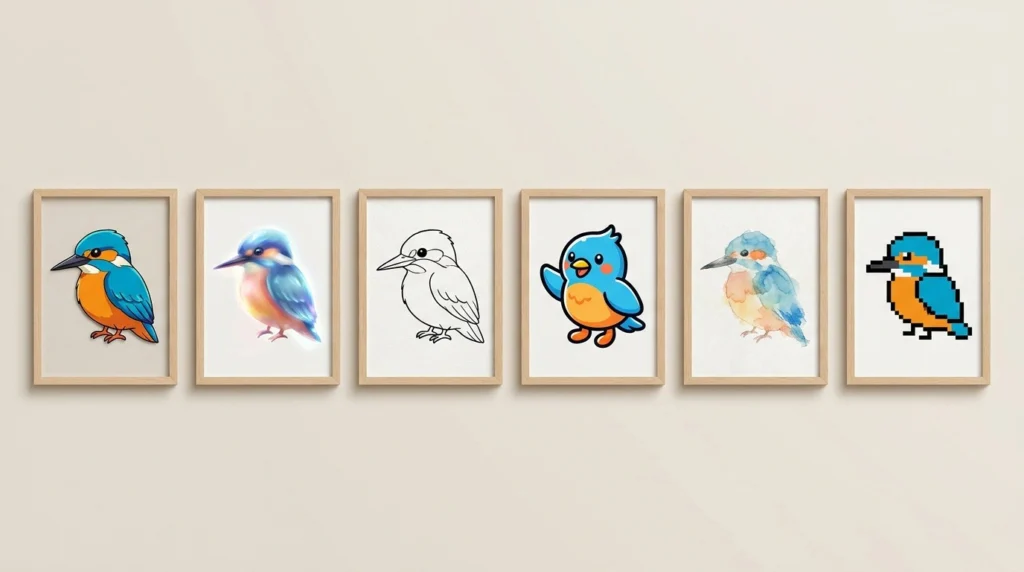
A Dictionary of Art Styles: From Line Drawings to Impasto, Printmaking, and Pixel Art, a Vocabulary of Illustrations Chosen by Purpose
The reason why "cute style" doesn't come across might be due to a lack of vocabulary. This is an illustrated guide that lists major art styles, from line art, flat painting, watercolor, impasto, printmaking, paper cutting, pixel art, and 3D style, along with the "suitable uses" for each style.
What is a key visual? — The difference from a main visual, and what to decide before creating it.
A key visual is the central image used across posters, websites, social media, and merchandise as the face of a work or campaign. This article outlines the differences between a key visual and a main visual, the criteria for a good key visual, and the distribution channels and rights that should be decided before creation.