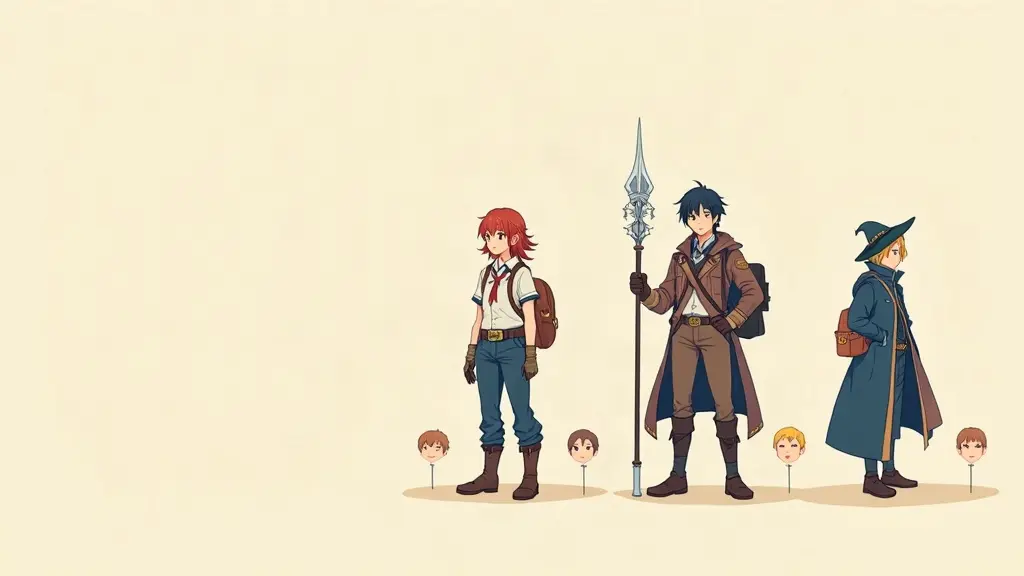
- A standing illustration is an image depicting a character standing, displayed separately from the background on the screen. It is used to indicate the character speaking in a dialogue scene.
- Tabletop role-playing games (TRPGs), visual novels (Novel Games), and social games (SNS games) have different display sizes, required differences, and data formats. It's important to communicate the intended use from the beginning.
- If you're using variations in facial expressions or costumes, please provide a list of how many of each variation you need when making your request. Adding variations later often leads to more adjustments.
- When arranging multiple characters side by side, it's necessary to establish agreements to ensure consistency in proportions, line thickness, and lighting.
- The scope of use will differ depending on whether it's for personal sessions or for games that are distributed or sold. The intended use should be communicated at the beginning of the request.
A standing illustration is a character illustration used separately from the background.
A "standing illustration" (tachie) is an image depicting a character standing , separated from the background and displayed on the screen. This includes characters appearing in dialogue scenes in visual novels, characters on the home screen of social games, and illustrations representing your character in online tabletop role-playing games (TRPGs). All of these are referred to as standing illustrations.
A key characteristic of character portraits is that they are treated separately from the background . A character image with a transparent background is overlaid on top of the background image. This allows the same character to appear in various scenes, or to change only their facial expressions. The premise of how they are created is different from typical illustrations, which are completed as a single image.
This article outlines the basics of character illustrations, the specifications that vary depending on their purpose, and things to decide when commissioning a character illustration. Note that character illustrations for Vtubers are not covered here, as the situation is significantly different, requiring model data for animation, etc. For information on Vtuber character illustrations, please refer to the articles on commissioning Vtuber illustrations and the invention of character illustrations .
Main scenes in which character portraits are used
Character portraits are widely used in scenes where characters are conversing or being introduced. The requirements vary depending on the intended use.
| Use | The scene that is displayed | It will become important |
|---|---|---|
| TRPG (online sessions) | Screenshots of the session tools, character introductions | The essence of one's character, the ability to recognize who it is even when displayed in a small size. |
| Novel games / Adventure games | Displayed on top of the background during a conversation. | Differences in facial expressions, a sense of unity when multiple characters are lined up. |
| Social games | Home screen, character details screen, conversation scenes | The fact that they are visually appealing even when displayed large, and the differences in rarity and costumes. |
| Video commentary and live commentary | The person speaking is displayed at the edge of the video screen. | Mouth opening and closing, facial expression changes, and ease of viewing when positioned. |
Even though the term "character portrait" is used, the scale and arrangements differ greatly depending on whether it's a portrait commissioned by a single player for a tabletop role-playing game (TRPG) for their own character or a portrait commissioned for many characters in a game production. It's crucial to specify the purpose, screen location, and size of the portrait at the beginning of the request.
The scope and angle of the drawing—whether to draw the whole body, from the knees up, or a bust shot.
When creating a character illustration, you have the option to select the "range" of how much of the character to depict.
- whole body...From head to toe. Suitable for character introductions, character lists, and when you want to show off costumes.
- On the knees...This range is often used in conversational scenes. Facial expressions and upper body movements are easily visible.
- breast enhancement...From the chest up. Suitable for when you want to show facial expressions in detail or when the screen is small.
Even if only the upper body is actually displayed, some people draw the whole body in advance in case they want to use the whole body later. However, the larger the area to draw, the more work is required. Check which areas will be displayed on which screens, and then decide in consultation with the artist.
The orientation of the characters is also important. When two characters are placed side-by-side in a conversation scene, it looks more natural if they are both facing inward. If you plan to use the image flipped horizontally, make sure there are no elements that would look unnatural when flipped, such as hair partings, clothing patterns, or accessories.
Differences—facial expressions, poses, and outfits.
In character illustrations, it's common to create images where only a part of the same character is changed . This is called a "variation." It's used to change facial expressions according to the content of the conversation or to change costumes according to the scene.
| Types of differences | Message | Things to consider |
|---|---|---|
| Facial Expression Differences | Laughing, getting angry, being surprised, being sad, etc. | Which emotion is needed? Should the eyes and mouth be switched separately? |
| Pose variations | Change the position of your hands and the orientation of your body. | Can it be used in combination with facial expression variations? |
| Costume differences | Everyday clothes, uniforms, seasonal clothes, etc. | Should I change my hairstyle or accessories too? |
| Opening and closing of the mouth | Mouth movements when speaking | Whether to use it in the production of videos or conversations |
Adding variations later often leads to more adjustments . In particular, you need to decide from the beginning whether to combine facial expression variations by separating them into eye and mouth parts, or to draw them one by one. Listing the necessary variations by working backward from the scenes in which they will be used will make both the request and the quotation process smoother.
Data format - background transparency and layering
Since character sprites are used overlaid with backgrounds, they are generally delivered as data with a transparent background . If you plan to use variations, you may need data with each part separated into different layers.
Here are some points we would like to confirm at the request stage:
- Should I receive the image with a transparent background?
- Should the differences be received as individual images, or as data separated into parts?
- Are there any specified sizes or formats in the tools or game development environment you'll be using?
- Should I also receive the original data with the layers separated?
The appropriate size and format will vary depending on the tools used and the game development environment. In game development, it's helpful to coordinate the specifications for character portraits with the programmers and designers beforehand to make post-delivery work easier.
When collecting multiple characters
When commissioning character illustrations for a game or other project, consistency is crucial when they are displayed together. Even if each character is appealing individually, if their proportions, line thickness, and coloring styles are inconsistent when placed side-by-side, the entire image will look disjointed.
To maintain consistency, it would be a good idea to make the following arrangements:
- Body proportions and standards for height differences between characters
- Line thickness, color, and coloring method
- Direction of light
- The position of your feet and the reference point for your standing position on screen.
This arrangement is especially important when commissioning multiple artists. One approach is to use the first artist's work as a benchmark and then use that as a model for the rest. For ideas on character design, refer to the character design article .
How to proceed with the request—from design confirmation to revisions
While there may be slight differences depending on the client, the process for creating character illustrations generally proceeds as follows:
- Consultation...Share the purpose, the screen size and size of the display, the drawing area, the necessary differences, the data format, and how it will be used.
- Character reference materials exchange...I'll provide the character description, reference images, color specifications, personality traits, catchphrases, etc.
- Checking the rough draft...Check the pose, body orientation, costume, and overall atmosphere.
- Line art and coloring...Finish it according to the predetermined rough draft.
- Creating differences...After the basic character portrait is decided, variations in facial expressions and costumes are created.
- Delivery...Receive the data in the specified format and display it on the actual screen for verification.
It's common practice to create variations after the basic character illustration is finalized . This is because changing the pose or outfit at the basic illustration stage would require revising all the variations already created. Checking the rough draft at a size close to how it will actually appear on the screen allows you to quickly notice problems such as the face becoming distorted or blending into the background color when scaled down.
If the character's image exists only in the client's mind, like in a tabletop role-playing game (TRPG), providing details such as personality, past, and catchphrases in writing will give the writer clues to consider expressions and poses. The key is to gather both visual references and character-based references.
Checklist before making a request
- Have you decided on the intended use and the screen size and dimensions to display it?
- Have you decided on the area to draw (full body, above the knees, bust-up) and the direction?
- Have you created a list of the necessary differences based on the situations in which they are used?
- Have you checked the data format, such as background transparency and layer separation?
- When creating a set of multiple characters, did you establish a unifying standard?
- Have you written down how you plan to use it (personal sessions, videos and streaming, distribution and sales)?
Scope of use—for personal sessions or for distribution/sale?
The scope of use that needs to be agreed upon will vary depending on how the character illustration will be used.
- Used in personal TRPG sessions...This will be displayed on the screens of the people you're playing with. It is often treated as being for personal use.
- The session will be made public through videos and live streams....This will be seen by a large, unspecified audience. We must also disclose whether or not it generates revenue.
- Used in games that are distributed or sold....For commercial use, broader agreements will be necessary.
- Used for merchandise and advertising...For uses other than character portraits, separate arrangements may be necessary.
If you plan to publish a TRPG session as a video or stream, you need to check the terms of use for the rules and scenario you are playing, in addition to the agreement on character portraits. Be sure to communicate all your intended uses at the beginning of the request. The etiquette for commissioning artists individually is summarized in the article on paid illustration requests , and the basic concepts of rights are summarized in the illustration copyright guide .
Please note that the concepts discussed here are general in nature. If you are unsure about the terms of rights or contracts, please consult a professional.
- What's the difference between a character portrait and a regular illustration?
- While typical illustrations are completed as a single image including the background and composition, character portraits (standing poses) are designed to depict only the character and be displayed on the screen separately from the background. Therefore, they are often delivered as data with a transparent background, and variations in facial expressions and other details may be combined and used.
- Do you need the character illustration to be a full-body drawing?
- It depends on the intended use. If only the upper body is displayed on the conversation screen, then a shot from the knees up or a bust-up might suffice. On the other hand, if the entire body is to be shown on the character introduction or list screen, then the whole body is necessary. It's best to explain which screens will display what area of the image and discuss it with the client to be sure.
- 差分とは何ですか?
- A "difference" is an illustration of the same character with only minor changes, such as facial expression, hand position, or clothing. These are used to change facial expressions to match the content of the conversation. Determining how many of each difference are needed by creating a list of the scenes in which they will be used will make the request and quotation process smoother.
- Is it okay to use character portraits from a tabletop role-playing game (TRPG) session in videos or live streams?
- It depends on both the agreement regarding the use of character illustrations and the terms of use for the rules and scenario being played. If you plan to publish it in a video or live stream, please inform the artist at the time of the request and also check the guidelines of the rules and scenario.
- Would the same approach apply when commissioning a character illustration for a VTuber?
- While the basic concepts are the same, there are additional arrangements, such as the need for model data to animate Vtuber character illustrations. Details regarding Vtuber illustration commissions are covered in a dedicated article.
* The illustrations featured in this article are original works created specifically for this media outlet. The copyrights to the works, characters, and product names mentioned in this article belong to their respective owners.
OSERU IMG.
You can consult with us about the content of this article when you're actually working on your project.
OSERU IMG. This is a creative studio comprised of illustrators, character designers, and motiongraphers.Search by style and track record, then contact us directly.Yes, we can. We welcome inquiries even if you're still in the "undecided" stage.
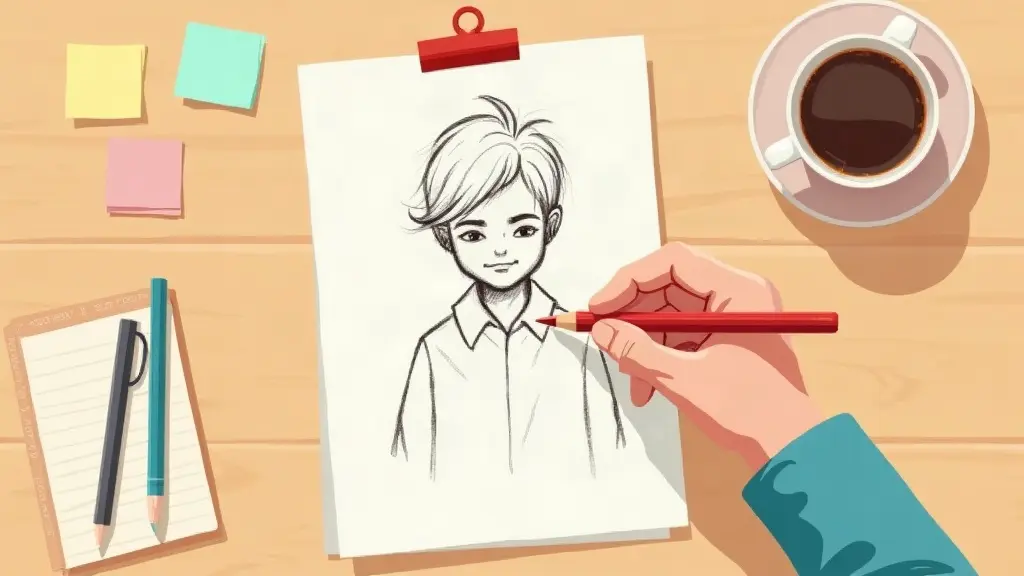
How to interpret illustration roughs—things to check upon arrival and how to return them.
When you commission an illustration, you'll receive a "rough sketch" before the final version is complete. This rough sketch is a preliminary drawing to determine the composition and pose, and it's not the stage for reviewing details or colors. This guide outlines what to check upon receiving the rough sketch, how to apply it to your actual intended use, how to summarize internal confirmations, and how to respond.
Commissioning illustrations for a VTuber—deciding on the format (standing illustration, variations, and model data) beforehand.
When commissioning artwork for a VTuber, simply asking for a single standing illustration isn't enough to move the project forward. We've organized the items that the client should decide on beforehand, from how to handle facial expression variations, layering for animation, division of labor between the artist and modeler, to how to determine rights with monetization and merchandise in mind.
Why can't the going rate for illustration commissions be expressed in a single table? — Six factors that determine the estimate.
Why is it that when you look up the going rate for commissioning illustrations, all you get is "it depends on the conditions"? This guide will organize the six conditions that influence the estimate—purpose, scope of use, duration, and exclusivity—so you can understand the breakdown of the cost yourself. We've also summarized items that are likely to result in additional costs.