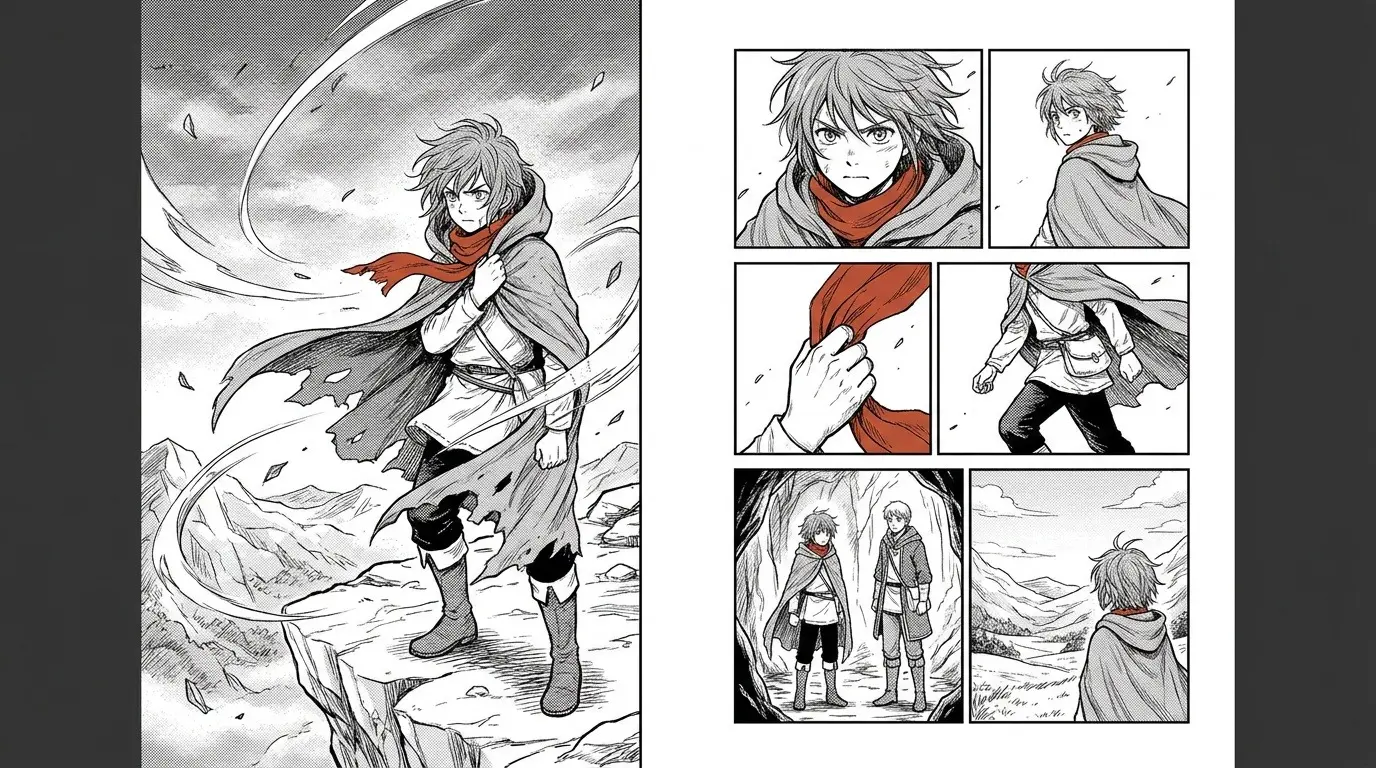
- Illustrations tell stories through space, while comics tell stories through time. They deal with different dimensions.
- The definition of "good" varies. In illustrations, it's about the precision of density, composition, and color design; in comics, it's about the reader being able to follow along without getting stuck.
- The most unique technique in manga is not the drawing itself, but the panel layout, which is essentially editing (composition, rhythm, pacing, and omission).
- The required level of consistency for a character is vastly different. An illustration only needs one best angle, but a manga character needs to appear as the same person from every angle, expression, and pose.
- If you're commissioning an illustration from a manga artist, clearly communicate that it should be a single, complete image, and establish the required level of completion beforehand.
- If you're commissioning an illustrator to create a manga, the first thing you need to decide is who will create the storyboards (rough panel layouts). Ambiguity at this stage is the biggest cause of problems.
- Changing the panel layout after the artwork has been drawn is almost equivalent to redrawing it.
"I want to commission someone who can draw"—this is the most common request I hear in the production field, and also the one that causes the most problems. Even though both manga and illustrations use the same pen and tablet, they are almost completely different disciplines.
This isn't a matter of skill level. It's about the fundamentally different "way of speaking" required. It's like comparing a 100-meter sprint to a marathon and arguing which is faster—it's pointless. In this article, I'd like to break down the structural differences between the two and organize the points that will be useful in practice for both those commissioning and those receiving the work.
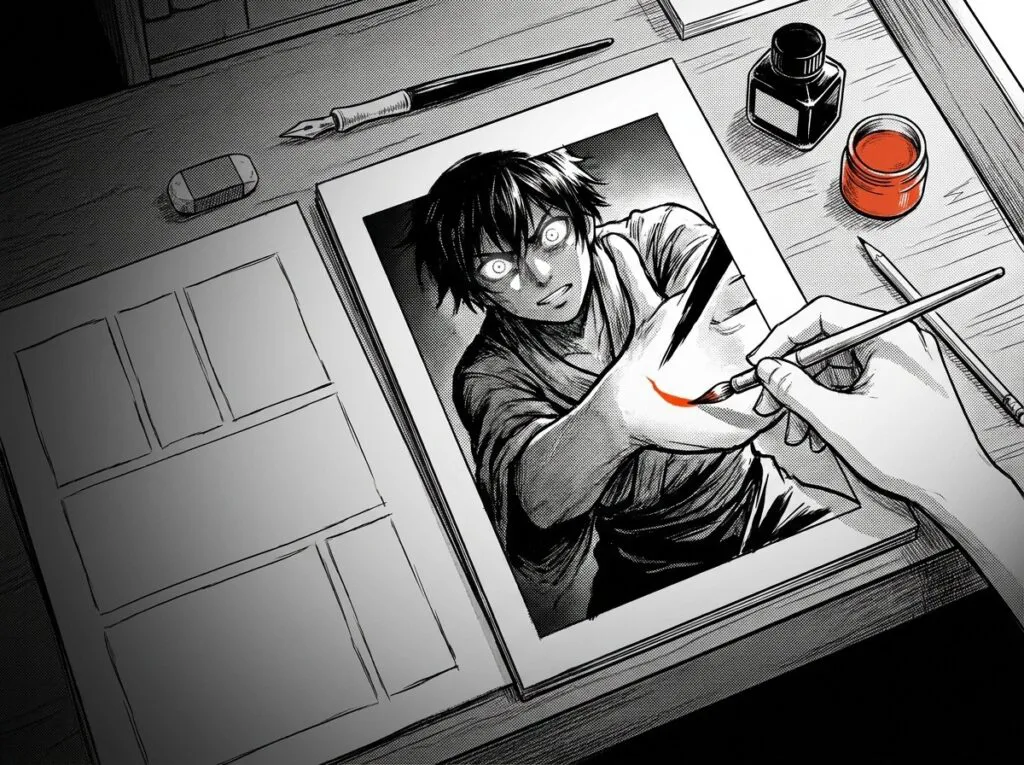
A painting that tells a story in one image, and a painting that tells a story over time.
The biggest difference lies in the dimension they deal with. Illustrations speak in space. Within a single frame, they cram in the character's personality, the season, the context of the story, and even the smells and temperatures. The reader is given only a fleeting moment to scroll. Therefore, illustrators pack information into that instant, while also precisely controlling what they subtract to prevent the image from becoming cluttered by cramming too much in.
Comics tell stories through time. What wasn't shown in the first panel can finally be revealed in the third. Even the physical break of turning the page can be used as a narrative device. Conversely, individual panels don't need to be complete. In fact, if too many panels are too complete, the reader's eyes will stop at each panel, making the comic difficult to read.
The definition of a "good drawing" is shifting.
If this point doesn't click, the meeting will remain at a standstill. In the context of illustration, "good" often refers to density, composition, color design, and finishing precision. In the context of manga, "good" refers to the reader being able to read through it without getting stuck, and emotions moving in the intended direction at the intended points. The former is a static level of perfection, the latter is the design of movement.
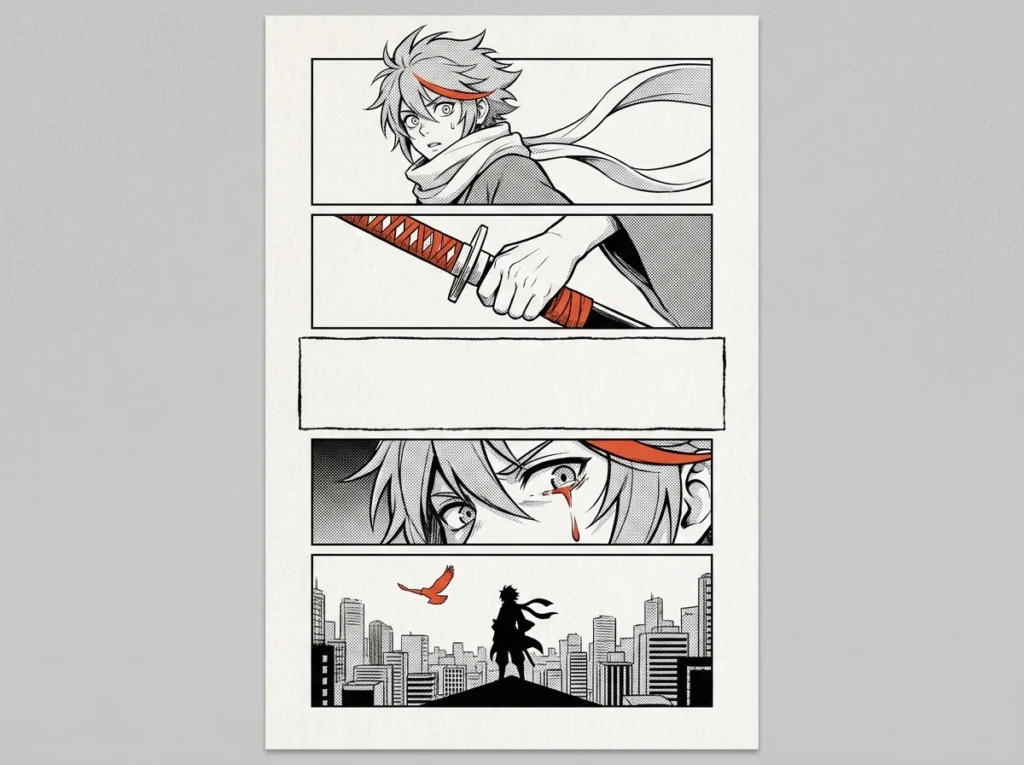
Therefore, there are manga artists whose work is incredibly engaging even with rough lines, and there are artists whose single illustrations are breathtakingly beautiful, but whose continuous pages suddenly become difficult to read. Neither is a flaw. They simply have different skills honed.
Panel layout is not about drawing, but about "editing".
Perhaps the most unique technique in manga is not the drawing itself, but the paneling. And what paneling actually does is editing.
- What information to present, and in what order (structure)
- How much time should be allocated to each frame (rhythm)
- Where to stop the reader's attention, and where to let them move on (pacing).
- And what not to draw (omitted)
Large panels are a signal to "stop here," while rapid succession of small panels is like pressing the fast-forward button. Effect lines convey speed, tones convey temperature, and white space conveys silence. Even panels with nothing drawn on them convey information in the form of "space." In other words, before drawing a line, a manga artist makes dozens of decisions on each page that are similar to those made by a video editor.
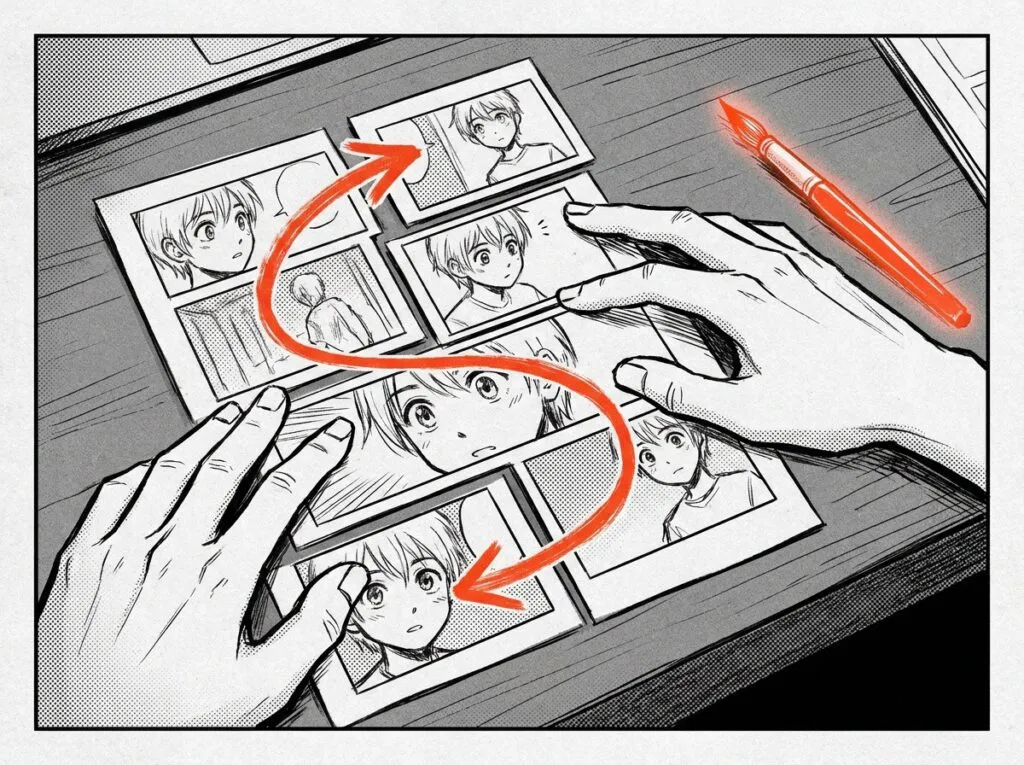
Adopting this perspective reveals the true nature of the skill of "being able to draw manga." It involves not only drawing ability, but also the basics of direction, composition, and scriptwriting, as well as a sense of how to distribute information within the physical container of a page. In other words, it's like handling the editing work all by yourself. That's why you can't estimate the cost of manga by simply multiplying the number of drawings by the unit price. This is because there are far more decisions that are discarded before the final drawing is completed than the number of drawings that are actually shown.
The character consistency and required standards are on a completely different level.
Another often overlooked difference is character consistency. With illustrations, you only need to choose one angle that makes the character look best. But that's not the case with manga. Whether you're looking at them from above, from below, from behind, crying, laughing, or running, the reader must continue to recognize them as the same person.
| Perspective | Illustration | Comic |
|---|---|---|
| Required angle | One best angle is enough. | Every angle, expression, and posture |
| How to allocate animation costs | Concentrate your attacks on one point. | Distributed across the entire page |
| Units that maintain consistency | Complete within a single image | Maintained in tens to hundreds of frames |
| The effects of the collapse | It can be resolved with just the problem of that picture. | Readers misinterpret it as "a different person". |
This difference is reflected in the very way character designs are created. Designs that can withstand manga are recognizable by their silhouette, maintain their shape even with fewer lines, and are designed so that the artist can draw them hundreds of times without losing their form. Conversely, designs that look good as single illustrations often derive their appeal from the amount of detail and the gimmicks themselves. It's not a matter of one being superior to the other, but rather that they are intended to be used in different ways. If you can determine in the early stages of IP development whether "this character will become a manga character, merchandise, or animation character in the future," the subsequent processes will become surprisingly easier.
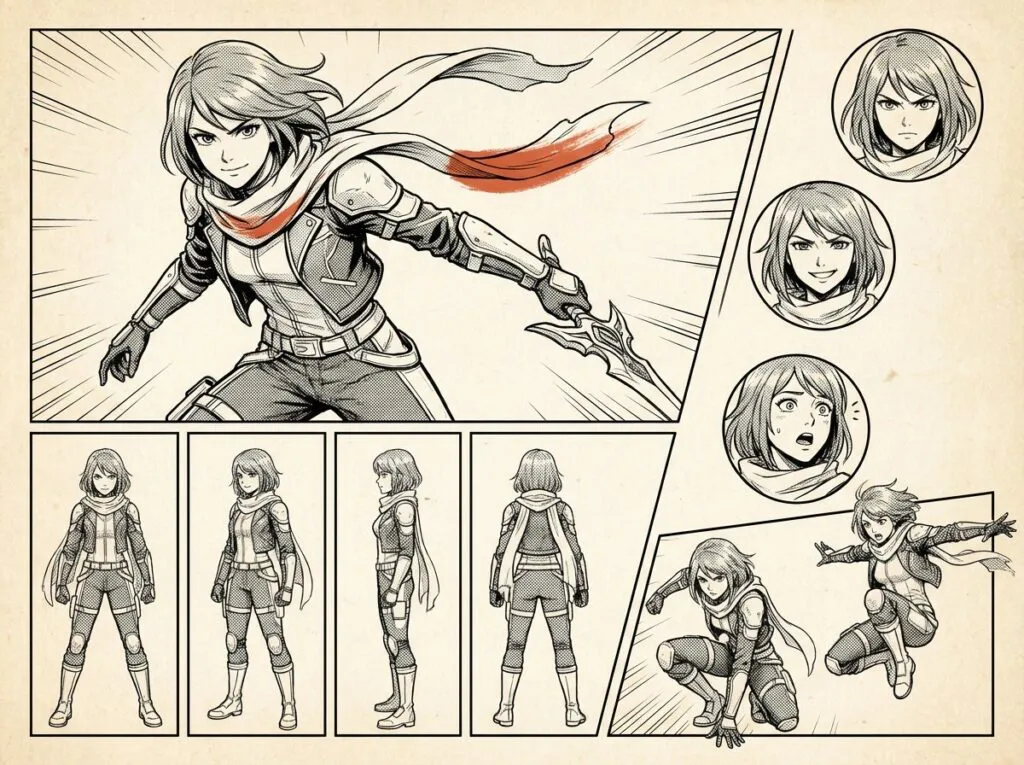
When commissioning an illustration from a manga artist / When commissioning a manga from an illustrator
When commissioning an illustration from a manga artist
- Clearly communicate that the story should be complete in a single image. The design of an image that hints at a continuation of the story is completely different from an image that closes the story there.
- First, establish the desired level of finish. Expecting a thick, painted texture from an artist who has primarily relied on lines and tones will lead to misunderstandings.
- Its strengths lie in its narrative and expressiveness. If you're looking for a picture that allows you to imagine what happened before and after that moment, then this is a very good fit.
When commissioning a manga from an illustrator
- The first thing to decide is who will create the storyboards (rough panel layouts). Leaving this ambiguous is the biggest cause of problems.
- Having a different person handle the script and composition, allowing the artist to focus solely on drawing, is also an effective division of labor. Using only what each person excels at is not disrespectful; it's a sound design.
- There's a trade-off between the number of pages and the density of the artwork. If you increase the number of pages while keeping the density the same, the workload will increase dramatically.
- The position of the speech bubble and the amount of text should be designed at the same time as the illustration. If you add the text later, it will usually hide the face.
What's common to both approaches is the importance of not misjudging "what kind of person that is and how they've been telling their story." The quality of the final product will visibly change depending on whether you can cast someone after understanding each writer's style of storytelling.OSERU IMG. Creator IntroductionWhen browsing lists like this, try adding another perspective beyond just your preference for the art style: "Does this artist tell a story with a single image, or through a series of images?" This should significantly improve the clarity of your selection process.
Advertising comics, an intermediate realm
The advertising comics and comic adaptation projects that we see so often these days are right on the border between these two areas. What's required is a combination of comic book readability and the appeal of illustrations. It's a rather difficult job that requires being ambidextrous.
- The ability to compel readers to finish the article (it fails to function as an advertisement once readers leave).
- The ability to grab attention with the first panel or thumbnail (this is similar to illustration work)
- Each page has a unique vertical and horizontal layout. Vertical scrolling and double-page spreads are completely different reading experiences.
- The accuracy of the message. The balance between freedom of expression and the facts that need to be conveyed.
The pitfall here lies in the very assumption that "if it's in comic form, it will be read." While comics are certainly an easy format to read, the cost of keeping readers engaged is by no means cheap. By cutting down on the number of panels and cramming in only information, you can end up with something that's neither comic nor illustration, but more like a difficult-to-read slide presentation with pictures. Before choosing a format, you should decide whether what you want to convey can be contained in "one page, or if it requires more time."
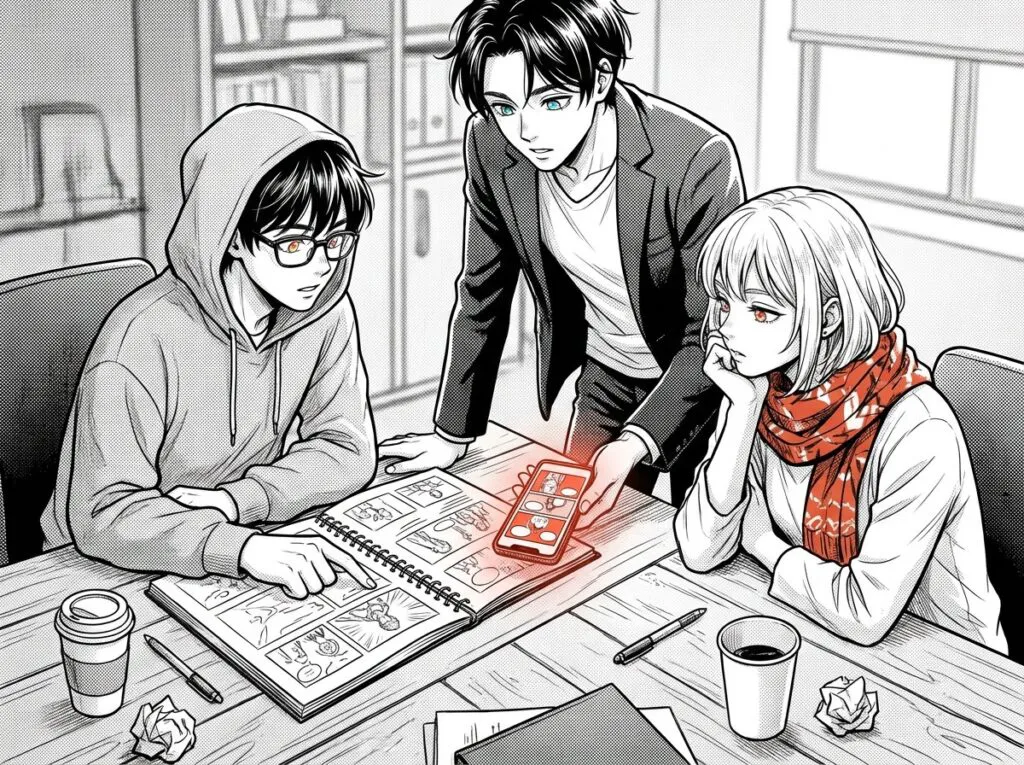
Spending too much time on a story that could be told in one picture makes it redundant, and cramming a story that requires time into one picture makes it more of an explanation than a picture.
Five things you should know before placing an order
- ObjectiveDo you want to make an immediate impression, or do you want to guide them through the process step by step?
- Location of the nameWho creates the structure, and who approves it?
- The future of the charactersTo what extent is it possible to develop this art style and setting further in the future?
- Scope and number of revisions: Understand that changing the panel layout after the artwork has been drawn is almost equivalent to redrawing it.
- Delivery formatLayer separation, text/no text, and aspect ratio variations.
Simply articulating these five points in the initial meeting will visibly reduce the exhaustion in the later stages of the project. Conversely, skipping this step often leads to the most frustrating situation: the artwork is complete, but no one is satisfied.
Ultimately, both are about "the art of making people want to read."
What distinguishes manga from illustrations is how they handle time. Illustrations freeze time in a single point, while manga lets time flow. However, their purpose is the same: to leave something in the viewer's mind. A great illustrator can infuse the pace of a story into a single image, while a great manga artist can make each panel stand on its own as a single image. The boundary is much more fluid than you might think.
The important thing is to know where that boundary lies and then intentionally cross it. If you're unsure during the planning stage, try deciding whether it's a single piece or a series before commissioning the artwork. Just doing that will surprisingly clarify who you'll commission, your budget, and your schedule.
- What is the difference between manga and illustrations?
- It's about how time is handled. Illustrations condense personality, season, and the events before and after of a story into a single frame, freezing time into a single point, while comics arrange panels to show the flow of time. The goal is the same: to leave something behind in the viewer's mind.
- What is the difference between a "picture" and an "illustration"?
- "Picture" is a broad term referring to anything that has been drawn, while "illustration" often refers specifically to pictures created for a purpose or use, such as in advertisements, books, products, or on the web, to convey something. Comics are also a type of picture, but the skills required for an illustration, which conveys a message in a single image, and for a comic, which conveys a message over time through a series of panels, are vastly different.
- Is panel layout a drawing technique?
- It's all about editing techniques. It involves deciding what information to present and in what order (composition), how much time to allocate to each frame (rhythm), where to pause and where to let the viewer's gaze move (pacing), and what to leave out (omission). Large panels are a signal to "stop here," while rapid succession of small panels is like fast-forwarding.
- What should you keep in mind when commissioning an illustration from a manga artist?
- Please clearly communicate that the piece should be a self-contained work. The design of a picture that hints at a continuation of the story is completely different from a picture that closes the story on its own. Also, expecting an artist who has built their work on lines and tones to naturally produce a thick, painted texture will lead to misunderstandings.
- What should you keep in mind when commissioning an illustrator to create a manga?
- The first thing to decide is who will create the storyboards (rough panel layouts). Leaving this ambiguous is the biggest cause of problems. It's also effective to have someone else handle the script and composition, allowing the artist to focus on drawing. It's not disrespectful to use only what you're good at; it's a good design.
- What should I keep in mind before placing an order?
- There are five points: the purpose (should it make an immediate impression or be understood step by step), the location of the storyboard (who creates it and who approves it), the character's future (how far will it develop later), the scope and number of revisions (changes to panel layout after drawing almost always require redrawing), and the delivery format (layer separation, with/without text, aspect ratio).
* The illustrations featured in this article are original works created specifically for this media outlet. The copyrights to the works, characters, and product names mentioned in this article belong to their respective owners.
OSERU IMG.
You can consult with us about the content of this article when you're actually working on your project.
OSERU IMG. This is a creative studio comprised of illustrators, character designers, and motiongraphers.Search by style and track record, then contact us directly.Yes, we can. We welcome inquiries even if you're still in the "undecided" stage.

A 0.5-second battle on the shelf. A single label determines the character of the product; it's the blueprint for the package illustration.
To ensure a product is chosen in 0.5 seconds on a shelf, what should be discarded and what should be retained in the packaging illustration? From printing constraints and coexistence with legal labeling to designing a series, this book traces the process of creating a single image that defines the product's character, step by step.

Example and template texts for illustration requests: 8 items to include in your first message.
What should you write in the first letter when requesting an illustration? We've compiled ready-to-use examples and an 8-point template that ensures your message is conveyed effectively. We cover everything in a practical order, from how to write a letter that is less likely to be rejected, to how to rephrase ambiguous terms, how to request revisions, and 5 points to review before sending.
Designing Corporate Characters to Last: 7 Steps to Creating Character Designs
If you start with a cute design, no one will use it after six months. When creating a corporate character, we decided on the role, silhouette, number of colors, facial expressions, and tone of voice before even drawing the illustration, and organized everything from the supervision regulations to the mass production design in the order it would appear on the ground.