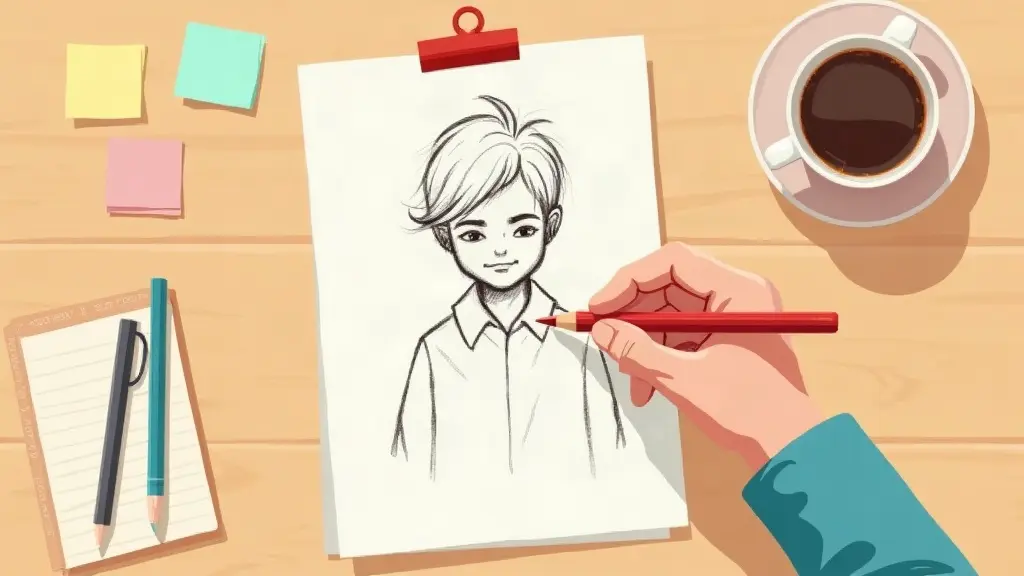
- A rough sketch is a preliminary drawing used to determine the composition, pose, placement, and overall atmosphere. The roughness of the lines and the presence or absence of color are not things to be judged at this stage.
- What I want to check in the rough draft is whether it suits the intended use, whether all the necessary elements are included, whether the main subject is conveyed, and whether there are any issues that might cause problems in later stages of the process.
- By comparing the rough draft to the actual layout, size, and cropping shape, you can quickly notice any overlapping or cropping issues with text.
- When multiple people within the company need to review something, one person gathers all the opinions, prioritizes them, and then returns them to the author.
- If you want to change the composition or pose, it's easiest to communicate this at the rough sketch stage. If you have any doubts, feel free to ask questions before making a decision.
After commissioning an illustration, you'll often receive a message from the artist saying, "The rough draft is ready." This is where people who are commissioning an illustration for the first time tend to get stuck. The lines are rough, and there's no color. They don't know if it's good or bad, what to look at, or what to say in response—I hear this kind of thing often.
The initial review of the rough sketch is where the client can exert the most influence during the commissioning process. Any issues noticed at this stage can be incorporated into the final artwork with minimal effort. Conversely, if you simply approve it as "OK for now," you may need to make major revisions after the coloring is complete. This article will outline what aspects to consider when reviewing a received rough sketch, how to verify it, and how to respond.
What is a rough sketch? What is it meant to decide?
A rough sketch is a preliminary drawing created before the final illustration. In most cases, illustrations progress in the order of "rough sketch → line art → coloring → finishing," with the rough sketch being the first stage. The breakdown of the process itself is explained in the complete guide to commissioning illustrations .
The role of a rough sketch is to determine the framework of the drawing before adding details . Specifically, the following things are decided at the rough sketch stage:
- 構 図...Where to place things on the screen, how big to draw the main character.
- Pose and expression...What posture and facial expression do the people and characters have?
- Positioning elements...Positional relationships of products, accessories, background, and margins for text.
- Overall atmosphere...Is it bright or calm? Is it active or quiet?
Conversely, the neatness of the lines, the fine details of the patterns, each individual strand of hair, and the precise colors are not yet decided at the rough sketch stage. Even if the rough sketch has color, it is often just a temporary color to convey the atmosphere and may differ from the final color. The level of detail in the rough sketch varies greatly from artist to artist. The roughness of the rough sketch itself is not a factor in judging the quality of the artwork.
Things to check with the rough draft that arrived
Once you open the rough draft, first take a look at the whole picture and put your first impression into words. Then, check the following points in order.
| Perspective | To verify |
|---|---|
| Is it suitable for its intended use? | Considering where and how large it will be displayed, is the composition and the size of the main subject appropriate? |
| Are all the elements I want included? | Are all the people, products, items, and scenes mentioned in the request included? |
| Will the main character come across? | When you take a quick look, does your eye go straight to the thing you want to show off the most? |
| Does it match the facts? | Check if the product's shape, the placement of uniforms and logos, and the names of buildings and places are accurate to the real thing. |
| Will this cause problems in later stages? | Can it accommodate things that might be needed later, such as margins for text, cropping, and repurposing for other uses? |
Of these, the most easily overlooked is whether it "matches the facts." Artists create their artwork based on the materials they are given. Fine details of the product's shape and internal company rules may go unnoticed by the client, and the project may proceed to completion without addressing them. Artists may also fill in gaps in the materials with their imagination, so please don't hesitate to ask about anything that concerns you.
When commissioning a character illustration, I also check if it matches the character's design. I look at the hairstyle, clothing, accessories, and facial expression to ensure they match the character's personality. Comparing it side-by-side with the character design sketches makes it easier to spot any discrepancies.
Let's try applying it to actual uses.
Simply viewing a rough sketch filling the entire screen can miss important details. The finished artwork will be used in various "places," such as on packaging, websites, posters, and social media posts. The most reliable way to verify the sketch is to place it in those locations and see how it looks .
- Try placing it in the layout....Place the rough sketches on a temporary screen or page of the design to check if they overlap with the title, description, or logo.
- View at actual size...Shrink the image to the size you'll be using it on, such as on a smartphone screen or flyer, and check to make sure the main subject doesn't become too small.
- Viewed in a cropped form...If the image is cropped into a shape other than a rectangle, such as for SNS icons, thumbnails, or merchandise, check to make sure it won't be cut off in that shape.
- Let's look at them side by side...to see if it stands out when placed on a shelf alongside other illustrations in the series or competing products.
Ideally, this confirmation should be done together with the person in charge of design, as there may be things that only the design team knows, such as the placement of text and the parts that will be cut off during printing. The concept of combining images with text, as in key visuals , is explained in the section on key visuals , and confirmations related to submitting merchandise are explained in the section on requesting illustrations for merchandise .
Even if you receive multiple rough drafts, comparing them by applying them to your intended use will allow you to choose not only based on your preference but also on "ease of use."
Things that don't need to be decided at the rough stage
Many of the reasons why people feel anxious when looking at rough drafts are because they are trying to judge things that haven't been decided yet at the rough draft stage. The following points are often resolved in later stages:
- The lines are rough, and the lines overlap.
- The facial details are sparse, making it difficult to discern the nuances of the expression.
- The color is either missing or a temporary color.
- The background and small objects are depicted using only their shapes.
- There is still no expression of light, shadow, or texture.
However, if you're unsure whether something will "be perfected later," don't leave it as is; ask questions. For example, if you ask, "How detailed will this part be in the final version?" or "Is this color just a placeholder?", the artist will explain how the finished product will look. It's more reassuring for both parties to ask questions before deciding than to approve something without understanding it.
On the other hand, if you have specific color requirements or colors you don't want used, it's best to communicate them during the rough draft stage to make the subsequent steps easier. Color considerations are discussed in the section on illustration colors .
How to proceed when checking within the company
When a company or organization commissions artwork, there are often multiple people reviewing the rough drafts: the person in charge, the designer, their supervisor, the product manager, and the public relations department. If each of them gives their opinion separately, the artist will end up receiving contradictory instructions.
- First, decide who will make the final decision....The most burdensome scenario is when someone else comes along after the rough draft has been approved and the composition changes. It's important that the person making the final decision always reviews the rough draft.
- Leave one person at the counter....We will gather the opinions with the person in charge at the contact point and return them to the authors in a unified manner.
- Prioritize your opinions...Separate your requests for things that "definitely need to be fixed" from those that you "would like to be fixed if possible."
- Resolving conflicting opinions within the company....Disagreements like "make it brighter" and "make it more subdued" are resolved internally before handing it over to the writer.
- Keep to the deadline for your reply...If verification takes time, it will cause delays in subsequent processes. The time required for internal verification should be factored in when creating the schedule.
When you're still getting used to internal confirmation processes, you can distribute the points listed in the table above as confirmation items and ask people to answer each one. This will help you reach a consensus.
How to respond to rough drafts—how to communicate OK and revisions
Once you've finished reviewing, send a reply to the artist. If there are no problems, give them your OK, along with a brief comment about what you liked. By telling them what you liked, you can ensure they continue in that direction as they move on to the next step.
If you need to request revisions, including the following three points will make it easier for your request to be understood.
- Where...Add marks and numbers to the rough image to pinpoint the location.
- How do you want to change it?...Write specifically the direction you want to change, such as "move to the right" or "make them smile."
- Why do you want to change it?...Add a reason, such as "because the title will go in this position." Knowing the reason will allow the author to come up with a better alternative solution.
It's best to communicate all revisions at once . Sending multiple revisions as they come to mind will force the artist to revise the drawing they've already started. Also, changing the composition or pose at the rough sketch stage is relatively less burdensome, while changes after the line art or coloring has progressed are almost equivalent to redrawing. The number and scope of revisions will vary depending on the terms of the request, so please proceed according to the details confirmed at the beginning.
Examples of how to communicate revision requests and ways to rephrase vague phrases like "make it cute" are provided in the illustration request template .
Checklist before reviewing the rough draft
Finally, here's a summary of items you can use when reviewing the rough draft. Please feel free to use this for internal review as well.
- Have you prepared the intended use, placement, and size that you mentioned when making the request?
- Does it include all the elements I want?
- At first glance, does your eye go to the main character?
- Are there any discrepancies between the product's shape, logo, and settings and the actual facts?
- Have you checked it by applying it to the actual layout, size, and shape that will be cut out?
- Did you consider the margins for the text and the parts that would be cut off during printing?
- Did you compile the points you couldn't decide into questions for the author?
- Did the person who makes the final decision see this rough draft?
- Can the corrections be communicated all at once, with the location, direction, and reason clearly stated?
Fees and revision arrangements vary depending on the terms of the request, and there is no uniform standard. The general idea is based on the market rate for illustration requests , and the process for commissioning an artist as an individual is explained in the section on paid illustration requests .
Summary—The rough draft is the easiest place to make corrections.
The rough sketch stage is where you determine the framework of the illustration. It's not about the roughness of the lines, but about whether the composition, pose, and placement of elements are suitable for the intended use. Check how it fits into the actual place where it will be placed. Summarize internal opinions and return them with consistent locations and reasons. Don't jump to conclusions about anything you're unsure of; ask questions. Just doing this will significantly reduce the chances that the finished illustration will be "different from what you expected."
Carefully reviewing rough sketches is also a way of respecting the artist's work. Clearly communicating the artist's intentions at an early stage directly impacts the quality of the final illustration. We also discuss different approaches to illustration depending on its intended use in our sections on outsourcing illustrations and character design .
- The rough draft looks messier than I expected, but is it okay to proceed as is?
- Rough sketches are preliminary drawings used to determine composition and placement, so it's normal for the lines to be rough and for there to be no color. What you should look at is not the neatness of the lines, but whether the composition, pose, and placement of elements are suitable for their intended use.
- I can't judge whether a rough draft is good or bad. What should I do?
- Trying out the rough sketches in the actual layout and size you'll be using will make it easier to decide. If you're still unsure, don't jump to conclusions; instead, ask the artist questions and have them explain how it will look in its final form.
- Is it okay if I tell you about the colors at the rough draft stage?
- If you have specific color preferences or colors you don't want used, letting us know at the rough draft stage will make the subsequent steps easier. However, it's difficult to judge the final colors from the rough draft's temporary colors, so fine color adjustments will be confirmed during the coloring stage.
- What happens if you want to change the composition after reviewing the rough sketch?
- Changing the composition after the rough sketch has been finalized can sometimes be almost equivalent to redrawing the entire piece. Whether additional costs or time will be required depends on the initial agreement and the artist's requirements, so please consult with us as soon as possible.
- How many rough drafts can you provide?
- The number of options varies depending on the artist and the nature of the request; there is no fixed number. If you would like to choose from multiple options, be sure to communicate this preference and confirm the conditions during the quotation stage.
* The illustrations featured in this article are original works created specifically for this media outlet. The copyrights to the works, characters, and product names mentioned in this article belong to their respective owners.
OSERU IMG.
You can consult with us about the content of this article when you're actually working on your project.
OSERU IMG. This is a creative studio comprised of illustrators, character designers, and motiongraphers.Search by style and track record, then contact us directly.Yes, we can. We welcome inquiries even if you're still in the "undecided" stage.

Where can I commission illustrations? – Four options and how to determine which is right for you.
There are four main ways to commission illustrations: crowdsourcing, direct contact via social media, agencies, and production companies. I've organized them based on four key factors—how pricing is determined, who manages the project, how rights are handled, and who can back you up in case of problems—to help you determine which method is best suited to your project.
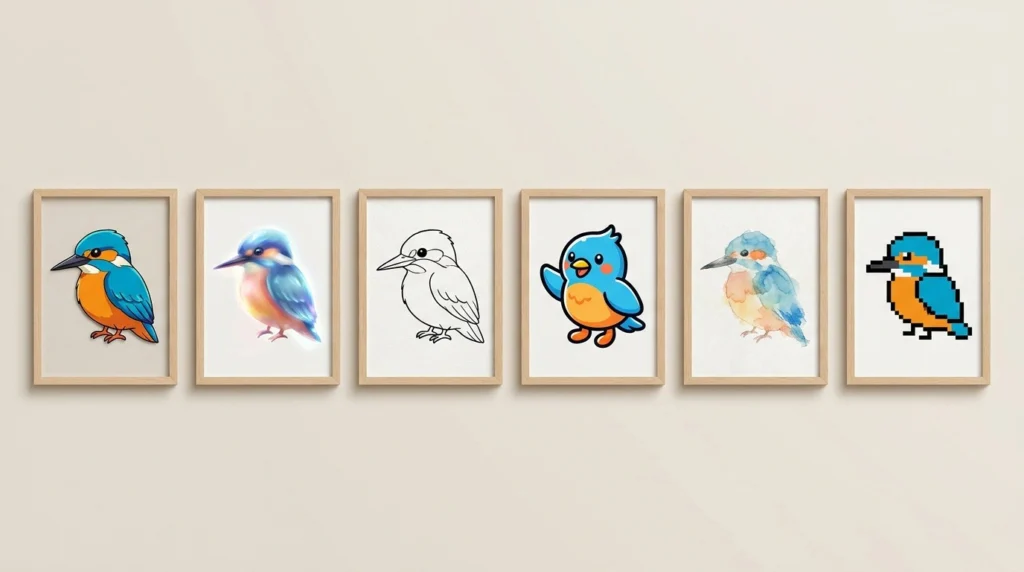
A Dictionary of Art Styles: From Line Drawings to Impasto, Printmaking, and Pixel Art, a Vocabulary of Illustrations Chosen by Purpose
The reason why "cute style" doesn't come across might be due to a lack of vocabulary. This is an illustrated guide that lists major art styles, from line art, flat painting, watercolor, impasto, printmaking, paper cutting, pixel art, and 3D style, along with the "suitable uses" for each style.
Outsourcing character creation—deciding whether to create it in-house or outsource it, and what to do after placing an order.
I've organized four key points to help you decide whether or not to outsource character creation, based on the system rather than your personal preference for the artwork. This includes the pros and cons of three different types of outsourcing partners, the processes involved after placing an order, the deliverables you should receive, and how to determine character-specific rights, all from the client's perspective.