- Misunderstandings in commissions occur not because of artistic skill, but because of communication. The starting point is to articulate "why you are drawing."
- It's faster if the intended use, publication size, and delivery format are decided before the content of the illustration.
- Provide reference images as a "standard," not as a "preference." Include a brief explanation of what aspects are similar.
- The biggest point of contention is the scope of use. Copyright transfer and licensing are different things, and the fees and considerations will differ accordingly.
- The number of revisions should be determined by both the "number" and the "scope." Divide the process into sections and create spaces where you can pause.
- The budget should be considered not as "drawing fees" but as "drawing fees + scope of use".
Ordering an illustration is somewhat like ordering at a restaurant. Sometimes you just point to something on the menu, and other times you simply say, "I'd like something a little nice today," and then fall silent when the dish arrives. The difference is that with illustrations, reworking them takes both time and money.
The patterns in which the client ends up losing money are surprisingly reproducible. It's not because they didn't have enough budget. Most of the time, it's because they started without deciding things that should have been decided in the first 30 minutes . This article is a practical guide for people who commission illustrations as work. It's written to be useful for both first-time commissioners and those who have been commissioning illustrations several times but are always feeling frustrated.
Ordering problems occur not with "pictures," but with "words."
When you receive an illustration and think, "This isn't what I expected," the reason isn't often due to poor drawing technique. In most cases, it's simply because the words in the request form could be interpreted in more than one way.
Here are some common misunderstandings.
- "Simplicity"—does that mean reducing the number of lines, limiting the number of colors, or cutting down on the amount of information?
- "Something cute"—does that mean round, delicate, or retro?
- "We'll use it for a banner"—is it just one banner, or five different sizes, or will you use it again next year?
- "If you could just make a slight adjustment"—does that mean changing the composition, or adjusting the colors?
None of them are malicious. However, for the artist, the interpretation of this one word can triple the amount of work. The motto when writing an order form is, "Can anyone other than myself read it in only one way?"
The starting point is "articulating the purpose."
The first thing to decide isn't the style of the artwork. It's what the artwork needs to accomplish professionally . If this isn't clear, all subsequent decisions will become based on personal preference, leading to confusion during internal reviews.
Let's begin by writing out the following three sentences one by one.
- Who will you show this to?—Age group, their relationship with the product, whether they are first-time customers or existing customers.
- What do you want people to feel?—Reassurance, exhilaration, trust, familiarity, and surprise
- What do you want me to do after watching it?—Read on, press, remember and take away
The request isn't "Please make it cute," but rather, "We want a 30-something who's unfamiliar with the service to look at it for 3 seconds and think, 'This doesn't look difficult.'" This difference directly translates to the quality of the final product.
If the objective is clearly articulated, revision instructions can be made more specific, such as "I want to lower the barrier to entry a bit, so make the lines thicker," rather than simply "make it cuter." When instructions are specific, the number of revisions naturally decreases.
The intended use, size, and delivery format are decided before the artwork is created.
This is a technical point, but it's also an area where changes are difficult to make later. If you say "I want a vertical orientation too" after you've started drawing, you should assume that this will generally incur additional costs. This is because it involves rearranging the composition itself.
| Use | Things to decide first | Points that tend to be overlooked |
|---|---|---|
| Web main image | Aspect ratio, cropping area for smartphones, margin for text | Alternative aspect ratio for SNS cards |
| Printed matter | Actual size, resolution, bleed, CMYK or RGB | Color dullness due to special features and paper quality |
| Accessories | Number of plates, area, and whether monochrome is possible. | Will the lines become blurred when the size is small? |
| Videos and animations | Whether or not parts are separated, layer structure | Splitting specification intended for later movement |
In particular , regarding layer separation and data format , if these are not specified in the request, the only valid delivery will be "compressed export data only." If you plan to move or change colors later, be sure to mention it from the beginning.
The reference image should be provided as a "standard," not a "preference."
Sending reference images is effective. However, simply pasting them can be counterproductive. The recipient won't know whether you want them to "look like this picture" or "capture just the general feel," and in the worst case, they might perceive it as a request for imitation. Requesting someone to directly copy another person's work is not legal or ethical.
A good approach is to add a line to each reference explaining "what you want people to look at . "
- Reference A: "ThisTone of the color schemeThat's all. Please don't use the character drawing techniques as a reference."
- Reference B: "ThisA sense of openness in the composition"Please take a look at the amount of white space."
- Reference C: "This isExamples of what not to do"It's too realistic, it's too stiff."
Including a negative example can be more effective than you might think. This is because the things you want to avoid are more clearly defined than the things you like. Additionally, providing screenshots of your company's existing creative work or the actual locations where the items will be displayed increases the likelihood of creating a visually harmonious image.
The biggest point of contention is the scope of use—"transfer" and "license" are two different things.
If we proceed without clarifying this point, we'll run into problems a year from now. In most cases, what's being exchanged in illustration transactions isn't the "picture itself," but rather the scope of the right to use it.
License and Copyright Transfer
| License | Copyright Transfer | |
|---|---|---|
| Location of rights | Remains in the creator's mind | Transfer to the ordering party |
| range of use | The media, duration, and region are determined by the contract. | In principle, no restrictions. |
| Cost | Varies depending on the range | It is generally more expensive. |
| Suitable cases | A project with limited uses | If you want to make it a long-term brand asset |
In practice, it's important to understand that under Japanese copyright law, completely transferring rights, including adaptation rights, requires a specific clause in the contract. A contract that simply states "all copyrights are transferred" leaves room for interpretation that rights related to modifications are not transferred. In addition, moral rights of the author cannot be transferred . The handling of modifications and attribution must be determined separately from the transfer. Since the application of specific articles differs from case to case, it is essential to consult with a legal professional or specialist for large-scale contracts.
The following items should be decided in advance by the ordering party:
- The media used (Web/Print/In-store/Video/Merchandise) and the number of items for each.
- The usage period (one-time purchase or annual renewal) and the region (domestic only or includes overseas).
- Whether modifications are permitted—cropping, color changes, reuse of parts
- Secondary use (repurposing for other campaigns, television exposure, advertising)
- Whether or not data can be used as AI training data is increasingly being requested to be clearly stated in recent years.
- Is it a monopoly or non-exclusive (whether or not it restricts provision to competitors)?
Credit notation
Credits involve not only deciding whether or not to include them, but also how they are presented . This includes variations in name spelling, placement, and whether to tag accounts when posting on social media. For creators, it's a portfolio piece that leads to future work, and for clients, it represents value beyond just cost. If you choose to omit credits, it's only right to negotiate that as part of the terms.
Rough draft stage, number of revisions, and budget considerations
Divide the process into smaller steps and create places to stop.
An approach where the finished product is presented immediately is risky for both parties. Generally, the process involves stages such as "rough sketch (composition idea) → line drawing → coloring → finishing," with confirmation at each stage. Sharing the rule that the composition should be finalized at the rough sketch stage significantly reduces the chances of problems. Changing the composition after coloring is practically equivalent to redrawing.
If internal approval is required, make it clear from the start who the final decision-maker is . The most painful mistake is when a superior steps in after rough approval and the situation is completely reversed.
The number of revisions should be written using both the "number" and "range" specifications.
Simply stating "up to two revisions" is meaningless if the content of each revision expands infinitely. It only becomes functional when you also specify "one revision per stage, all instructions at once" and "requests for more than the specified number of revisions, or for changes in composition, will be quoted separately." Consolidating revision instructions rather than sending them separately to each team member is also extremely important in practice.
The budget should be considered not as "drawing fee" but as "drawing fee + scope of use".
Even the same image can have vastly different values depending on whether it's used once in internal company documents or for three years in a nationwide advertisement. Rather than searching for market rates and applying a uniform figure, it 's healthier to work backward from how much the image will be used . When making a decision, organizing your thoughts using these four factors will help you avoid inconsistencies: workload (number of people, density of background and props), production period (whether it's urgent or not), scope of use, and whether it's exclusive.
Furthermore, excessively low quotes pose a risk to the client. Unrealistic prices often result in delays in delivery or a lack of flexibility for revisions.

When going through management vs. when making a request directly to an individual
It's not a matter of one being right or wrong; rather, each approach is suited to different situations depending on the nature of the project.
| Directly to individuals | via management | |
|---|---|---|
| exchange | Direct connection with the person, faster response time | The person in charge will be the point of contact. They will also handle coordination, including operational management. |
| Contracts and billing | The ordering party needs to make arrangements. | Often, this process results in a summary of conditions and a draft of the document. |
| Schedule | Depends on the individual's situation | It's easy to discuss alternative plans in case of delays. |
| Suitable projects | One-off, small-scale, emphasis on artistic expression | This is a continuing project involving multiple team members and complex rights issues. |
Like character developmentA job that is intended to be operated over a period of several years.For projects that involve both illustrations and motion, it's often cheaper in the long run to have someone who can handle both the rights and the operational aspects.OSERU IMG. This is the area where management companies for creators like this act as the point of contact. Conversely, for a single, one-off cut, it's easier to just ask directly.
Whichever you choose, if you fill in the following items before placing your order, you're unlikely to go too far wrong.
- Is your purpose (who you want to reach and what you want them to feel) expressed in a single sentence?
- Usage, size, aspect ratio, delivery format, and whether layer separation is necessary.
- Did you include a note in the reference image indicating "what you want people to focus on"?
- Scope of use (medium, period, region, modification, secondary use, AI learning, exclusivity)
- Whether or not credit information is included and how it is displayed.
- Process breakdown and the number and scope of revisions at each stage
- Final decision-maker and internal approval process
- Schedule (deadlines for rough draft, first draft, and final draft) and payment terms
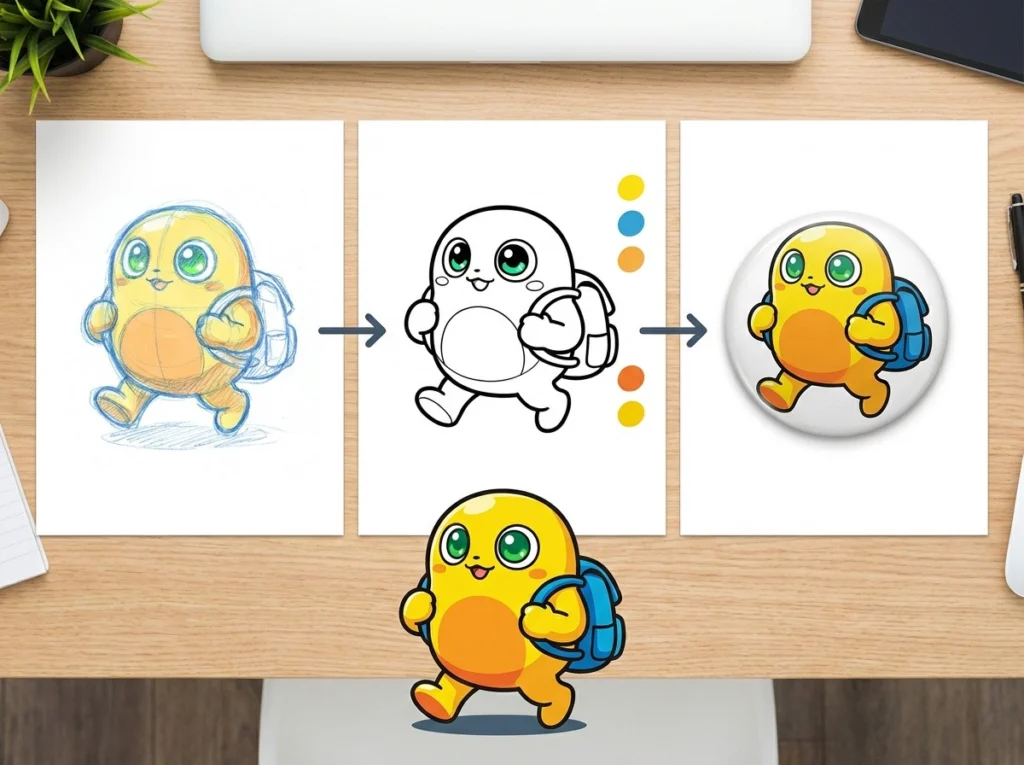
There's a common thread in studios where great paintings are produced: the client is able to explain in their own words what they want from the painting. That's far more effective than technical specifications. Conversely, it's almost a disaster when a masterpiece is born from simply handing everything over to the artist.
Ordering is a process where both the manufacturer and the orderer share the same map. Once that map is shared, the scope of trust and delegation expands surprisingly. If you can't organize everything internally, finding someone to consult with on how to refine the requirements is also a valuable ordering skill.
- What should you decide first when commissioning an illustration?
- First, the purpose. If you haven't decided who you want to communicate with and what you want to convey, you can't determine the purpose or scope of use, and you won't have a standard for judging the quality of the artwork. Next, you need to finalize the purpose, publication medium, publication size, and delivery format.
- Is it more common to request copyright transfer or usage permission?
- There's no single "normal" approach; it depends on the intended use. For projects with a fixed duration and medium, a usage license is often sufficient. However, if you plan to develop the character over the long term, it's more cost-effective in the long run to discuss transfer of use or broader licensing.
- How should I decide on the number of revisions?
- I write down not only the number of times but also the scope. Dividing the process into stages, such as "once at each stage of rough sketch, line art, and coloring," gives both parties a place to pause. Assuming there is no upper limit to the number of times will ultimately make things difficult for both parties.
- What is the difference between going through management and making a request directly to an individual?
- Direct requests mean less interaction between the client and the artist, as there are no intermediaries. Negotiations regarding terms, contracts, and billing procedures are handled directly between the client and the artist. Using a management company means that project management and contractual matters are handled by a single point of contact, making it easier to manage projects that require extensive internal approvals or clarification of rights.
- How many reference images should I provide?
- It's not about the number of points, but how you present them. Narrow it down to 2-3 points and write a brief explanation of "what it's similar to." The more points you include, the more the direction becomes blurred, and the more confusing your first draft will be.
* The illustrations featured in this article are original works created specifically for this media outlet. The copyrights to the works, characters, and product names mentioned in this article belong to their respective owners.
OSERU IMG.
You can consult with us about the content of this article when you're actually working on your project.
OSERU IMG. This is a creative studio comprised of illustrators, character designers, and motiongraphers.Search by style and track record, then contact us directly.Yes, we can. We welcome inquiries even if you're still in the "undecided" stage.




Color evokes emotions. 7 perspectives to transform illustration color schemes into "communicative designs."
Color arrives before lines. Hue as temperature, saturation as volume, color dialects that exist in each industry, how to use a single accent color effectively, and the option of monochrome. This is a practical guide to restructuring the often intuitive color schemes of illustrations into usable criteria for professional work.

Why do images convey meaning when they move? – An introduction to motion graphics: learning about easing and timing.
"Can this image be animated?" — Why does movement in a still image convey meaning? From the difference between motion graphics and animation, to the true nature of easing, designing 6-second/15-second/30-second timeframes, and the difference between vertical and horizontal orientations. An introduction to motion graphics that clients should know.

Why are "likable characters" so powerful? — The structure you should know before starting an IP.
Cute characters quickly become tiresome, while simple characters are loved for years. Where does this difference come from? This article explores the concept of "contextual vessels," the psychology of fan activities, the structure in which fans take on the role of publicity, and four steps to starting small.