
- The eight items to include in the first letter are: your name and contact information; how you heard about us; the nature of your request and the number of points; its purpose and publication medium; the scope and duration of use; the deadline; the budget; and the deadline for a reply.
- The biggest source of misunderstanding is adjectives. Phrases like "cute" or "emotional" should be rephrased using words describing lines, colors, and composition.
- When requesting revisions, write down the part you want changed and the reason why. Simply saying "it's not what I imagined" doesn't tell you where to move it.
- To make it less likely to be rejected, list specific examples of your work, be transparent about the budget and deadline, and include a response deadline and an excuse for declining.
- If any of the eight items are left unfilled, it's not something to ask the recipient about; it's something that hasn't been decided yet within the company. Decide on it first before sending it.
Many people get stuck on their first message when contacting an illustrator. They worry about being rude, whether they have enough information, and whether it's okay to jump straight into discussing the budget. Before they know it, their message ends up being a bland, inoffensive short message.
However, from a writer's perspective, requests that are too short are the most difficult to respond to. Since there's no information to determine whether they can accept the request, they have no choice but to start with questions, which ultimately prolongs the process for both parties.
This article provides ready-to-use example sentences and eight points to consider to ensure your writing is complete and accurate.
8 items to include in the first letter
| Item | Why is it necessary? |
|---|---|
| ① Name and contact information | The type of work you can get depends on whether you are an individual or a corporation, and what kind of business you run. |
| ② What did you see that made you contact me? | Which work you were drawn to best conveys your expectations regarding the style. |
| ③ Details of the request and the number of points | The approach will differ depending on whether it's a single image or a series. |
| ④ Purpose and publication medium | Where it's published affects both the price and the amount of work involved. |
| ⑤ Scope and duration of use | This is a point that can easily lead to disputes later on, so bring it up from the start. |
| ⑥ Delivery date | If the schedules don't match, it won't work out no matter how good everything else is. |
| ⑦ Budget guidelines | Not telling them would be unkind. It's okay to state it definitively within the scope of what you're saying. |
| ⑧ Deadline for a response | This makes it easier for both the person waiting and the person making others wait to move around. |
Ready-to-use example sentences
When you contact someone for the first time
Subject: Consultation regarding illustration production (XX Corporation / New product packaging)
Mr./Ms. ◯◯
This is my first time contacting you. My name is △△, and I am in charge of product planning at ◯◯ Corporation. I saw your artwork, "(Artwork Title)," and felt that the softness of the lines and the warmth of the colors were a perfect fit for the project I would like to request.
弊社で今秋発売する焼き菓子のパッケージに使うイラストを1点、あわせてSNS告知用の切り出しを2点お願いできればと考えております。掲載媒体はパッケージ、自社サイト、SNSの3つで、利用期間は2026年11月から1年間、非独占を想定しています。
If you can provide the first draft by [Month] [Day] and the final draft by [Month] [Day], we can schedule the project. We are anticipating a budget of around [Amount] yen, but please let's discuss and adjust the conditions.
Please let us know by around [Month] [Day] whether you can accept our offer. If you have any questions, please do not hesitate to ask. Thank you.
When requesting corrections
When requesting revisions, it's best to include both the parts you want changed and the reason why . Simply saying "it's not quite what I envisioned" won't tell the artist what needs to be changed.
Mr./Ms. ◯◯
Thank you for the first draft. The overall feel is exactly as I envisioned, and it was well-received within the company. I have just two points I'd like to discuss with you.
First, regarding the placement of the main baked goods: When placed on the package, the right edge is cut off, so could you please move it about 2-3 cm closer to the center? Second, regarding the background color: the shelves in the store are predominantly white, so I think making the background one shade darker would make the outline stand out more.
If any of these options are technically difficult, we would appreciate it if you could suggest alternative solutions.
Rephrasing words that tend to be ambiguous
The biggest source of misunderstanding in request letters is adjectives. The same word can evoke completely different images in different people's minds.
| A way of speaking that is difficult to understand | Effective ways to rephrase |
|---|---|
| Cute | I'd like the lines to be thinner and the overall look to be done with muted, neutral colors. |
| With an emotional atmosphere | I want the light to be like the backlighting of evening, when the shadows are long and drawn out. |
| Stylish | I want to reduce the amount of decoration and create a composition with more negative space. |
| Give it a luxurious feel | I want to limit the number of colors to three and use gold or foil effects in only one place. |
| Pop | I want you to arrange the primary colors and draw the outlines clearly. |
| I'll leave it to you, in a good way. | Please include these three points, and I'll leave everything else up to you. |
When paraphrasing is difficult, the quickest way is to include two or three reference works. Providing both examples that are "similar" and "different" will further improve accuracy.
To make it less likely to be rejected
- Please give specific examples of works....It's clear that this isn't a mass email using a pre-written template.
- Disclose the conditions first....We will not hide the budget and deadline.
- Please include a deadline for your reply....This reduces the burden on those who are reviewing the matter.
- Leaving room for rejection...The phrase "Please let us know if it is difficult"
- Write about how to handle credits....Whether or not to reveal the author's name is an important factor in the decision-making process.
Furthermore, constantly nagging someone for a response is counterproductive. It's better to quietly move on after the deadline has passed and contact them again at another time; this will lead to a better relationship in the long run.
5 things to review before sending
| Places to see | Common omissions |
|---|---|
| Is the intended use written there? | The request simply says, "We'd like to request an illustration," without specifying where it will be published. |
| Is the period written there? | I wrote the delivery date, but forgot to write the usage period. |
| Is the score written there? | I intended to order just one main dish, but it seems they're thinking it includes the slicing as well. |
| Did you give the budget some flexibility? | If you specify the price in 1-yen increments, there is no room for adjustment. |
| Is there a deadline for a reply? | Without a deadline, decisions tend to be postponed. |
One more thing. Please make sure that the recipient's name and the title of the work are correct . Mistakes such as inconsistencies in the spelling of names or listing a work by a different author will be perceived as a request that was not carefully reviewed.
Things to decide between receiving a reply and the first draft.
If they agree to accept the request, I will finalize the following points before starting to draw. If these points are unclear, I will have to go back and redo a lot after seeing the first draft.
- Actual size and margins of the page...the area to be cut, the position where the logo overlaps
- Elements to include and elements to exclude...Things you must draw, things you must not draw
- Number and timing of checks...Which stage should I look at: the rough sketch, the line art, or the colored version?
- Approval...Ultimately, who is it that says, "Let's go ahead with this"?
- Delivery format...Resolution, color mode, presence or absence of layers
It's especially helpful to agree on the timing of confirmations beforehand. If you finalize the composition at the rough sketch stage, major revisions after coloring will almost never be necessary.
Common writing mistakes
| Writing styles to avoid | Why is it a problem? |
|---|---|
| "Please feel free to discuss the budget with us." | It's difficult for the artist to specify a price. Please indicate a range beforehand. |
| "Just show me the rough sketch for now." | Rough sketches are also part of the work. I'm hesitant to accept requests for them if they're offered without compensation. |
| "It's a simple drawing, so I think it can be done quickly." | The client has already determined the estimated workload. |
| "If it's not what you envisioned, please feel free to revise it as many times as needed." | We cannot accept revisions with no upper limit. |
| "I'm also reaching out to other people at the same time." | Getting multiple quotes is normal. However, it's more honest to inform them beforehand rather than proceeding silently. |
| "It will spread around, so it will become part of your track record." | Proposals to offer exposure as compensation are often rejected. |
Competitive bidding and confirmation of disclosure of past performance.
There's absolutely nothing wrong with contacting multiple writers at the same time. What you need to be careful about is how you communicate your interest.
- Tell me first...I'll add the phrase, "I've consulted with several people."
- Pass the same conditions...If you change the conditions for each person, it's not comparable.
- We will always return the results....We will also contact you if we decide to see you off. This will help us connect with you next time.
- I won't do a rough comparison....This would mean collecting the creative works for free.
Another often overlooked point is confirming whether it's okay to publicly share the work as part of your portfolio . For an author, a portfolio is an asset that leads to future work, but for the client, it may be a product that hasn't been released yet or a confidential project. If you agree on "when it can be made public" and "how much can be written" at the time of the commission, you can avoid any last-minute rush.
FAQ
Is it okay if I send it via DM on social media?
It's fine if the author is acting as the point of contact. However, direct messages (DMs) tend to get lost in the stream of messages and aren't suitable for discussing complex matters. A more practical approach is to send an initial message via DM and then follow up with details via email. Even in that case, be sure to clearly state the purpose of your inquiry in the DM.
What should I do if I don't get a reply?
I'll wait about a week and then send a brief follow-up message. If there's still no response, it's wise to assume that it wasn't meant to be this time and move on. There may be circumstances that aren't visible to me, such as the order status or the customer's health.
Can I request services from a corporation even if I am an individual?
Yes, it's possible. However, the contract and billing procedures may differ depending on whether you are an individual or a corporation. When you introduce yourself in the initial letter, stating which entity you are representing will make it easier for the recipient to plan their approach.
Is it the same when communicating in English?
The core principles of the eight points remain the same. In fact, because the language is different, it's more effective to clearly state the four points of use, scope, duration, and exclusivity in bullet points. Similarly, including reference works instead of relying on adjectives is equally effective.
Keep it as a template
Having a template with 8 items to fill in within the company ensures that the quality of requests doesn't decline even if the person in charge changes. If there are any fields that remain unfilled, it's not something to ask the other party about, but rather something that hasn't been decided internally yet . If you decide on those things first before sending the request, the conversation will move forward from the very first message.
The request letter serves as both a document that provides writers with information to help them make a decision and a tool for clarifying what you want to create . The process of filling in the eight items itself clarifies the outline of the project. If doubts arise while writing, it means that those doubts have been identified before they can be conveyed to the other party.
* The illustrations featured in this article are original works created specifically for this media outlet. The copyrights to the works, characters, and product names mentioned in this article belong to their respective owners.
OSERU IMG.
You can consult with us about the content of this article when you're actually working on your project.
OSERU IMG. This is a creative studio comprised of illustrators, character designers, and motiongraphers.Search by style and track record, then contact us directly.Yes, we can. We welcome inquiries even if you're still in the "undecided" stage.

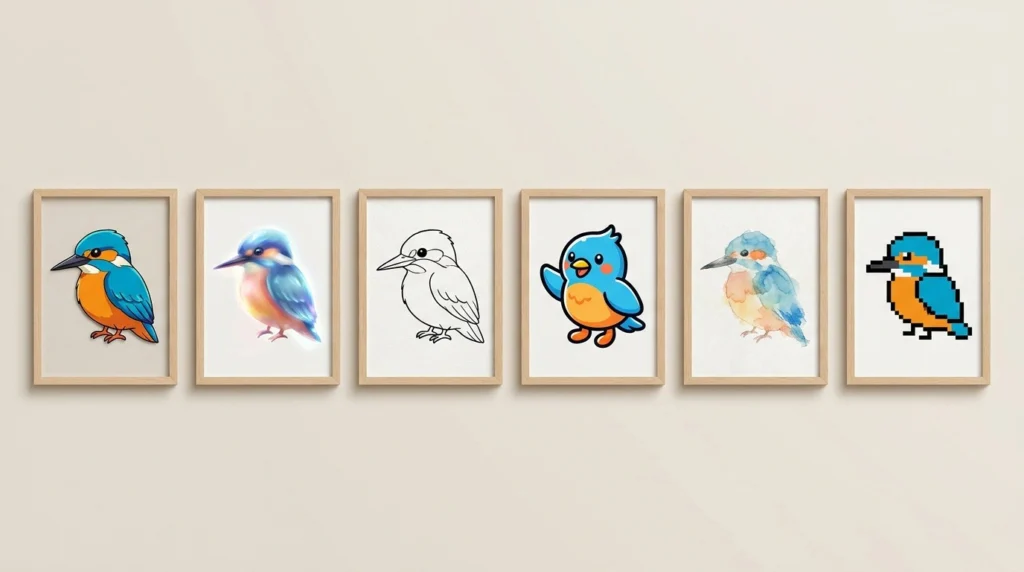
A Dictionary of Art Styles: From Line Drawings to Impasto, Printmaking, and Pixel Art, a Vocabulary of Illustrations Chosen by Purpose
The reason why "cute style" doesn't come across might be due to a lack of vocabulary. This is an illustrated guide that lists major art styles, from line art, flat painting, watercolor, impasto, printmaking, paper cutting, pixel art, and 3D style, along with the "suitable uses" for each style.
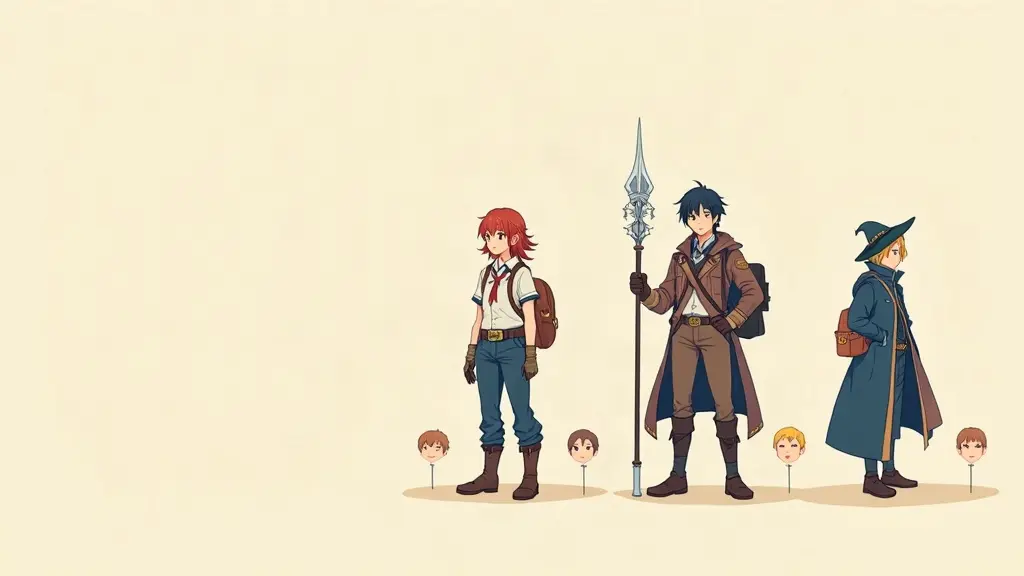
What are character portraits? — How specifications vary between TRPGs, visual novels, and social games, and key points to consider when making a request.
A character portrait is an image depicting a character standing, displayed separately from the background in dialogue or game screens. This guide outlines the specifications, which vary depending on the application (e.g., TRPGs, visual novels, social games), and outlines important points to consider when commissioning character portraits.

How far does copyright in illustrations transfer? — The difference between licensing and copyright transfer.
Even when you commission illustrations, the copyright doesn't automatically transfer to the client. This article explains the difference between licensing and copyright transfer, what rights remain with the artist after the transfer, and what items to check in the contract, from the client's perspective. We also provide guidelines for various scenarios and three common problem areas.