
- There are four ways to request services: crowdsourcing, direct contact via social media, agency matching, and production companies/studios.
- In short, the difference between the four is whether you take on the risks of the process and your rights yourself, or entrust them to someone else.
- While crowdsourcing offers upfront pricing, the displayed price doesn't always include the extent of the work that can be used. Commercial use and secondary use often incur additional charges.
- While direct communication via social media offers the highest degree of stylistic consistency, designing the scope of use, duration, and number of revisions, as well as contracts and billing, all become your own responsibility.
- The price of an illustration is determined by the conditions, not the route. Differences in the route affect the cost of intermediation and project management, not the price of the illustration itself.
- Trying to decide the route first will only lead to confusion. Decide in this order: How many points are needed / How far will you use them / Until when / Who will make the decision?
- When changing the route midway, the conditions (purpose, medium, duration, reference image) can be carried over, but the rough sketches and line drawings created by the previous artist cannot.
I want to commission an illustration. When I search for it, I find many comparison articles of services. However, they mostly just list prices and the number of registered users, and I often don't know which one is right for my project .
To organize your requests, it's helpful to think of them by their "path" rather than their "service name ." There are four main categories, each with distinctly different areas of expertise.
There are four main types of places where you can request this service.
| Route | How does it work? | Suitable projects |
|---|---|---|
| ① Crowdsourcing/Skill Market | Requests are made directly to individuals registered on the platform via the screen. | The number of items is small, and their purpose is clear. We want to keep the budget down. |
| ② Directly via social media | View the artwork and contact the artist directly. | This wouldn't work with any other artist's work. The style is the deciding factor. |
| ③ Agency/Matching | An agency that represents writers will introduce people who meet the requirements. | I want to compare the options. I want to consolidate the contracts and invoices. |
| ④ Production companies and studios | I take on the entire project, handling everything from arranging the writers to managing the project's progress. | There are many points. There are many people involved. I want to consult from the planning stage. |
This isn't about which is better. Using ④ for a single illustration would be excessive, and trying to develop a character to a level of 50 using only ① would be difficult.
① Crowdsourcing/Skill Market
You search for artists on screen, select your requirements, and then make a request. The price is often displayed from the start, making it easy to plan ahead.
| Special skill | Be careful |
|---|---|
| The price is visible in advance. | The displayed price does not necessarily include "how far it can be used." |
| They often start working on it right away. | Commercial use and secondary use often incur additional charges. Always check the fees. |
| You can try it with a small amount of money | It is not suitable for reconciling complex requirements. |
| The evaluation is visible. | High ratings indicate meticulous execution, but consistency in style is a separate issue. |
One thing to be careful about is the scope of use . Misunderstandings can easily occur, such as using an illustration commissioned at a personal use price for company advertising. If you intend to use it commercially, please discuss this from the beginning.
② Directly via social media
This is the most reliable route when you've already decided "this person is the one" after seeing their work. Since there's no one in between, the intention is conveyed directly.
- The degree of stylistic agreement is the highest....Of course, since I choose after seeing them.
- You need to design the conditions yourself....You decide and communicate the scope of use, duration, and number of revisions yourself.
- Contracts and billing are handled in-house....We handle everything in-house, from preparing documents and processing payments to handling withholding taxes.
- It's not guaranteed they'll accept it....Sometimes I'm not available, or I haven't been assigned that particular task.
If you choose this route, the quality of your request letter will directly determine the outcome. An article compiling example requests will be helpful in determining what to include and to what extent.
③ Agency/Matching
You consult with an agency that represents writers, and they introduce you to someone who meets your requirements. A key feature is that you can compare several candidates side by side.
| Special skill | Be careful |
|---|---|
| They can provide you with candidates that meet your criteria. | The selection will be from among the authors handled by the service counter. |
| Contracts and billing will be unified. | The brokerage fee will be included in the price. |
| You can see part of the progress. | The extent to which they examine you varies depending on the service counter. |
This is suitable for projects where the style hasn't been decided yet, but the requirements are clear. Conversely, if the artist has already been decided, option ② is often faster.
④ Production companies and studios
This involves taking on the entire project. This includes not only arranging for artists, but also clarifying the objectives, structuring the project, managing the progress, and ensuring consistency across multiple pieces.
- Effective when you have a high score....The more points you add up to—10, 50, and so on—the more valuable progress management becomes.
- You can consult with us from the planning stage....It's okay if you haven't decided "what you should draw".
- Suitable for projects with many stakeholders....There are several stages of internal review, and we are proceeding in collaboration with other companies.
- You can entrust all rights management to us....We can discuss the scope and duration of use.
- It's a heavy burden for a single request....because the entire operational structure will be used.
The key criterion for selection is "Who will bear the risk?"
In short, the difference between the four paths is whether you take on the risks of progress and rights yourself, or entrust them to someone else.
| 軸 | ①② (directly) | ③④ (to be inserted in between) |
|---|---|---|
| Price | Easy to suppress | The cost of mediation and facilitating the transaction will be added. |
| Presenter | Company | Contact person or production company |
| Contracts and billing | Prepared by our company | Get them all together |
| Design of Rights | You decide the conditions yourself. | It can be decided through discussion. |
| What to do when it stops | Rebuilding in-house | Often, alternative solutions are offered. |
If you have experience placing orders internally and can design the terms yourself, a direct route is more cost-effective. Conversely, if it's your first time placing an order, the deadline is fixed, and there are many internal checks, involving an intermediary will ultimately be faster.
Combinations that are prone to failure
| Things that people tend to do | What will happen? |
|---|---|
| Please provide the price for one item, assuming it will be distributed across multiple media outlets. | Additional charges for usage will be incurred later. |
| I'm asking someone I've never spoken to directly about a project with an unchangeable deadline. | There is no replacement when it stops. |
| To gather candidates, we asked several artists to create rough drafts free of charge. | The request was to collect the creative works free of charge, but it was rejected. |
| Proceeding without designating an internal decision-maker. | The back-and-forth verification process is lengthy, exceeding the limit on the number of revisions. |
| Choosing based solely on style, putting other conditions on the back burner. | The estimate didn't match the budget, so it had to be redone. |
When changing the route midway
Sometimes you might find that something isn't a good fit after trying it out. Changing things midway through isn't a problem, but there are things that can be carried over and things that cannot .
- Can be inherited...Purpose, publication medium, usage period, reference image, and size of the publication area. These are conditions, so they can be passed on to the next party as is.
- Cannot be transferred...These are rough sketches and line drawings by the previous artist. Since they are completed works, I cannot hand them over to someone else to continue drawing them.
The latter point is easily misunderstood. Even if you've paid for the work, the contract specifies "how much of the completed painting can be used." If you intend to hand it over to another artist to complete it, you need to agree on that premise from the beginning.
FAQ
Is it okay to try multiple routes simultaneously?
That's fine. However, please provide the same conditions . The scope of coverage differs depending on the route, so the prices cannot be compared unless the conditions are the same.
Can we commission an overseas author?
Yes, you can request this. However, it will increase the number of issues to consider, such as contract and payment procedures, time differences, and the governing law of rights. If it's your first time, using an intermediary will likely be less burdensome.
I'm hesitant to ask an inexperienced writer to do it.
The quantity of experience and whether the candidate is a good fit for the project are two different things. What you should look at is whether they have experience working on similar projects. If it's for packaging, then experience with printed materials is important because colors look different on a screen than when they are printed. Look for a match in application rather than just the number of works.
What should I do if I want to do it cheaply?
It's more effective to narrow down the conditions than to change the route . Limit the scope of use to only what's necessary, set a time limit, end the monopoly, and reduce the points. Shortening the deadline won't lower the price no matter what route you choose.
How do the approaches differ?
Even for the same request, "I'd like to order one illustration," the amount of work we have to do varies depending on the method we use.
| scene | ①② (directly) | ③④ (to be inserted in between) |
|---|---|---|
| Looking for a partner | Find and choose your own candidates. | When you tell them your requirements, options will appear. |
| Decide on the conditions | Design the scope, duration, and exclusivity yourself. | It can be finalized through consultation. |
| estimate | Communicate directly with the author | They are presented together. |
| Agreement | Prepare the document in-house. | There is a standard contract. |
| get on | Manage the timing of your checks yourself | Can you check the progress? |
| Payments | Process individually | It will be unified. |
One thing often overlooked when placing an order for the first time is the hassle of contracts and payments . It's not simply a matter of the artwork being good. When paying individuals, accounting checks may be necessary, such as how to handle withholding tax. If your company lacks experience in this area, it's worthwhile to have someone act as an intermediary, even if only for that part.
How do you estimate the amount?
It would be easier if we could say "it's roughly this much" for each route, but the cost of illustrations is determined by the conditions, not the route. Even with the same production company, the price of an illustration used once in internal documents will be orders of magnitude different from an illustration used for a year-long poster at a train station.
Therefore, when making comparisons, first finalize the conditions and then obtain quotes under the same conditions. The difference in routes affects the intermediary and project management aspects, not the price of the painting itself.
Order to decide
Trying to decide the route first will only lead to confusion. Reverse the order.
- How many points do you need?...Is it 1 point, or 10 points?
- How far will you use it?...Medium, duration, whether or not it's exclusive.
- Until when...Is it a deadline that can be moved, or not?
- Who decides?...How many stages are there in the internal review process?
If the score is 1-2 points, the conditions are clear, and there is ample time before the deadline, choose option ① or ②. If style is the deciding factor, choose ②. If you want to compare candidates, choose ③. If there are many points, you want to discuss the project from the beginning, and there are many people involved, choose ④. You can generally narrow it down in this order.
Once these four things are decided, the route will be narrowed down almost automatically. And the decided details can be used directly in the request letter. Decide what you want done before deciding who to ask. It may seem like a roundabout way, but this is the fastest way to proceed.
* The illustrations featured in this article are original works created specifically for this media outlet. The copyrights to the works, characters, and product names mentioned in this article belong to their respective owners.
OSERU IMG.
You can consult with us about the content of this article when you're actually working on your project.
OSERU IMG. This is a creative studio comprised of illustrators, character designers, and motiongraphers.Search by style and track record, then contact us directly.Yes, we can. We welcome inquiries even if you're still in the "undecided" stage.


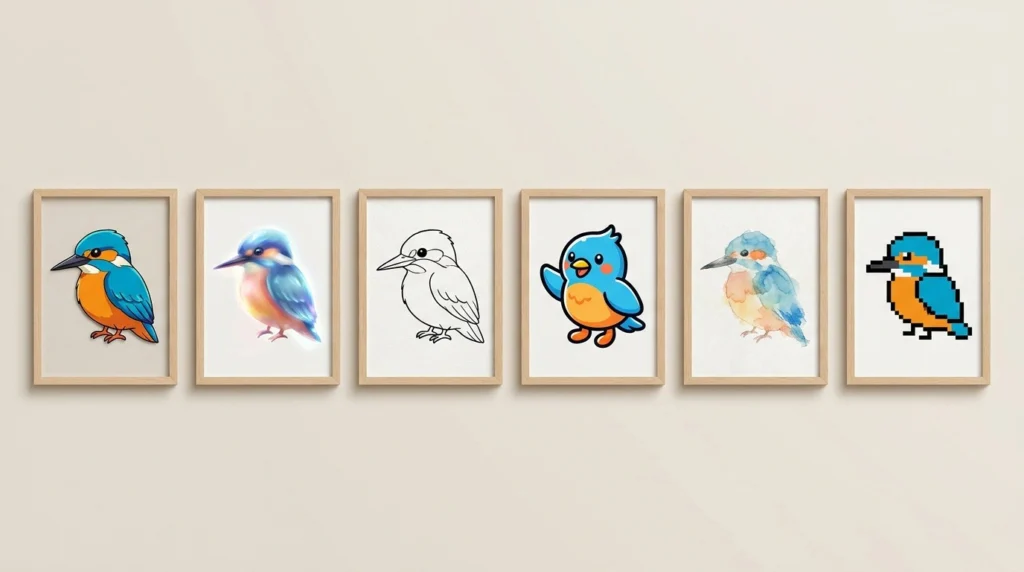
A Dictionary of Art Styles: From Line Drawings to Impasto, Printmaking, and Pixel Art, a Vocabulary of Illustrations Chosen by Purpose
The reason why "cute style" doesn't come across might be due to a lack of vocabulary. This is an illustrated guide that lists major art styles, from line art, flat painting, watercolor, impasto, printmaking, paper cutting, pixel art, and 3D style, along with the "suitable uses" for each style.

Example and template texts for illustration requests: 8 items to include in your first message.
What should you write in the first letter when requesting an illustration? We've compiled ready-to-use examples and an 8-point template that ensures your message is conveyed effectively. We cover everything in a practical order, from how to write a letter that is less likely to be rejected, to how to rephrase ambiguous terms, how to request revisions, and 5 points to review before sending.

Commissioning a key visual for a VTuber—things to decide beforehand for debut, new outfit, and anniversary announcements.
Key visuals for VTuber debuts, new costume reveals, and anniversary streams are commissioned as "a single image that will be used in various ways," separate from the character illustrations. Before drawing, we need to decide on the intended use, text elements, and release date, as well as confirm the character rights and organize the process.